How a NY Real Estate Company Avoided a 96% Premium Increase and Built a Talent Magnet Benefits Package
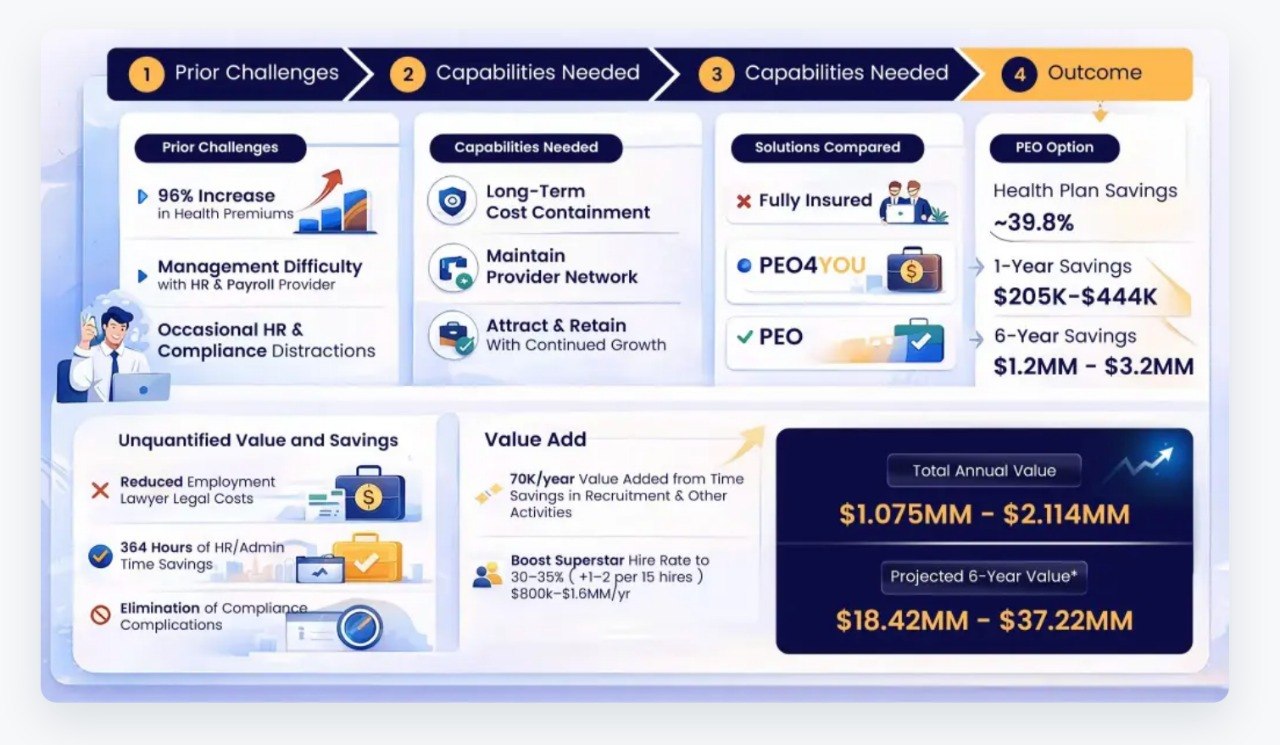
Company Profile: A New York-based real estate company that had outgrown the qualifications for state-based health insurance subsidies. The HR team was already certified on Rippling for payroll, and growth meant a renewed focus on talent attraction and retention as a top strategic lever.
The 96% renewal facing a NY real estate firm after the state-subsidy threshold passed
- 96% premium hike on the table: Loss of state-subsidy eligibility put the company in line for a 96% renewal increase at January.
- Rippling friction: The HR lead was certified in Rippling but found day-to-day use clunky relative to the price tag, with comparable platforms costing meaningfully less.
- No talent-attraction lever in place: The benefits package wasn't a competitive differentiator in a tight NY hiring market.
What a talent-magnet benefits package required in a competitive NY market
- Contain health benefit costs while preserving a broad provider network
- Support continued growth without onboarding a benefits team internally
- Shift the benefits package from cost center to recruiting tool
- Multi-state compliance protection as the company expanded past 100 employees
Six funding paths modeled: PEO vs Taft-Hartley vs level-funded vs captive vs MEWA vs fully insured
1. Fully Insured (status quo, top-10 broker quote)
Baseline rates from the original broker. The 96% increase that triggered the project.
✗ Unsustainable cost trajectory2. Taft-Hartley plan (strong alternative)
Projected savings: the Taft-Hartley alternative would have saved ~$2.12MM (38%) over 6 years vs. the prior BCBS gold plan — an option modeled, not the one chosen.
The long-game option they passed on: it renews at just ~3% a year (vs. ~8% for everything else), which makes it the long-run renewal winner even though the Prestige PEO starts cheaper — the gap compounds in the Taft-Hartley plan's favor over time.
Strengths: Flat-rate premiums independent of demographics, no payroll provider switch required, superior premium stability.
~ Strong alternative — would have won big on savings + long-run renewal stability3. Prestige PEO plan Selected
What they chose: the Prestige PEO health plan (UnitedHealthcare) — escaping the 96% increase and giving employees a 3-plan choice menu in place of the single prior plan: a $500-deductible plan, a $2,000-deductible plan, and a $7,350-deductible HSA plan.
Projected savings: depending on which plans employees choose, ~$1.9MM–$3.2MM (34–58%) over 6 years, all-in, vs. the prior BCBS gold plan. Per-plan modeled savings ran roughly $1.9MM (34%) on the richest $500-deductible plan, $2.2MM (40%) on the $2,000-deductible plan, and $3.2MM (58%) on the $7,350 HSA plan.
Strengths: World-class benefits package usable as a recruiting tool, an upgrade from one plan to a three-plan employee menu, dedicated compliance protection for multi-state expansion, enhanced customer service team, and HR and benefits administration offloaded so the team could scale past 100 employees without building an internal benefits function.
✓ Selected — the plan the owner chose4. Self-Funded
The group did not qualify for self-funded options at this size.
✗ Not eligible5-6. Level-Funded and Captive
Modeled but not preferred — neither matched the talent-magnet objective the way the Prestige PEO route did.
Why the PEO route delivered 5.8x–31x more talent-retention value than savings alone
A Taft-Hartley plan would have been the natural choice on simplicity and cost stability alone. What flipped the decision was modeling the talent attraction and retention value of a world-class benefits package against the marginal cost of the Taft-Hartley route.
Result: the expected 6-year retention value was 5.8x to 31x the expected health insurance savings — even though Taft-Hartley admin costs ran roughly 6x more than the alternative payroll provider.
Leadership reviewed the numbers with the head of HR, reversed an initial "PEO is out of bounds" stance, and committed to the Prestige PEO plan. The decision was made in a single short conversation once the business value of retention was quantified.
Outcome: premium controlled, talent-retention value compounded
- 96% renewal threat neutralized with a stable, demographically-independent premium structure
- Benefits package converted from a cost line into an active recruiting tool
- Compliance burden offloaded ahead of multi-state expansion
- HR and benefits administration handled by the PEO — growth continued without building an internal benefits team
Want this kind of result for your business?
A 30-minute discovery call models all six funding options against your actual situation. No pitch deck — just numbers you can defend in a board meeting.
Book a discovery call →