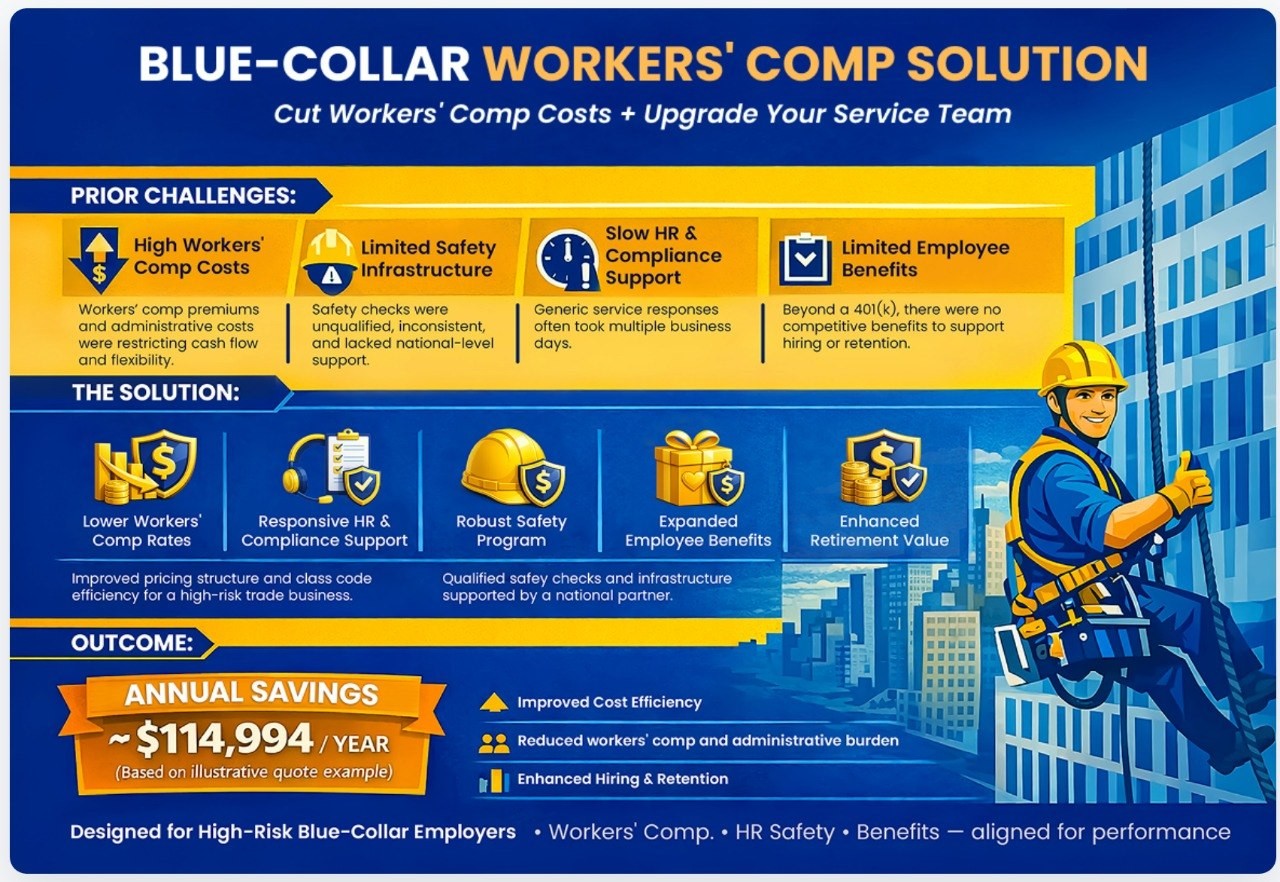
How Alumaline Cut $36K+/Year in Workers’ Comp & Admin — With a Model Projected to Save ~$115K as They Scale
The model at a glance
We came from ADP and would’ve been happy just saving the 28% on workers’ comp. What we didn’t expect was real employee benefits, faster support, and a simpler experience across the board. Easier to hire, easier to retain good people, and morale is stronger. We came for the savings and ended up with a partner that helps our business win.

Company Profile: Alumaline Inc. — a New York City contractor specializing in aluminum window and curtain-wall installation on high-rise buildings across the five boroughs. Roughly 13 employees and ~$1.5M in annual payroll, spread across high-risk installation, sales, and clerical workers’ comp class codes. Payroll and HR ran through ADP TotalSource, one of the largest national PEOs, and a 401(k) was the only employee benefit in place beyond what payroll required.
The problem: high-risk workers’ comp rates and stalled benefits inside a general-purpose PEO
- High workers’ comp costs across multiple class codes — the high-risk installation code (5102 NY) alone carried a 17.24% service-fee/WC load, cutting directly into project margins
- Generic HR & compliance support not built for a high-risk construction trade
- Stalled benefit expansion — conversations about adding real employee benefits to compete for skilled labor never made it to execution
- For a growing trades business, the drag wasn’t just cost — it was financial friction and lost competitiveness baked into the setup
What the right fit required
- Lower workers’ comp rates across every class code — especially the high-risk installation work
- Responsive HR & compliance support with a real service team, not a call center
- A benefits suite that could expand recruiting power without forcing employer contributions
- A clean payroll/WC transition with no disruption to active projects
The analysis: ADP TotalSource vs. FrankCrum, modeled on real payroll
1. Status quo — ADP TotalSource (largest national PEO)
Familiar, but expensive where it hurt most. On ~$1.5M of payroll, the bundled workers’ comp + admin load totaled roughly $131,650/year, with the high-risk installation code priced at a 17.24% service fee.
✗ Status quo unsustainable2. FrankCrum — a PEO built for blue-collar trades
Modeled against the same payroll, FrankCrum came in at roughly $95,164/year all-in:
- High-risk installation WC rate cut from 17.24% to 11.17%, plus a lower NY SUTA rate
- 5 dedicated service specialists with direct support — no more call-center handoffs (plus EPLI & FrankAdvice HR)
- +25 benefit lines available with no required employer contribution
- A clean activation with no disruption to active jobs (live December 2025)
Documented result: ~$36,486/year saved at current size — the large majority of it workers’ comp.
✓ SelectedOutcome: $36K saved today, a model that scales toward ~$115K
At Alumaline’s current size, the move to FrankCrum documents an annual saving of:
$36,486 / year
Because the savings are driven by workers’ comp rates applied to payroll, the dollar figure grows as Alumaline grows. Modeled against the headcount and payroll expansion expected from their pipeline of new projects, the same structure is projected to save on the order of ~$115,000/year at full scale — a projection, not a current figure, but a direct function of the rate improvements already locked in.
Just as important: Alumaline gained a path to real benefits competitiveness without paying for the benefits — making it materially easier to recruit and retain skilled installers in a tight NYC labor market.
Want this kind of result for your business?
A 30-minute discovery call models all six funding options against your actual situation. No pitch deck — just numbers you can defend in a board meeting.
Book a discovery call →