
In this article 4 sections
"What's the best health plan for my company?" is the wrong question. There is no single best plan — there are different funding paths, and the right one depends on your headcount, your claims history, and how much risk you are willing to hold in exchange for savings.
This page is the map. Benefitra supports seven funding arrangements, each solving a different problem. Below is what each one is, who it fits, and where to go deeper. As an independent, carrier-neutral brokerage, we have no incentive to steer you toward one product — only toward the one that actually fits.
- There is no universally "best" health plan — only the right funding path for your size, claims experience, and risk tolerance.
- The seven paths run from fully-insured (carrier holds all risk) to self-funded (you hold it, with stop-loss protection), with level-funded, captive, ICHRA, PEO-integrated, and Taft-Hartley in between.
- Smaller/risk-averse groups usually start fully-insured or level-funded; mid-size groups with clean claims explore self-funded, captive, or ICHRA.
- Model the numbers before you switch — our free funding projector compares paths side by side with no login.
The Seven Funding Paths
1. Fully-Insured
The carrier holds all the risk and you pay a fixed premium. Predictable and simple, but you never see a refund when claims come in low. Best for 5–30 employees or any group that prioritizes simplicity over savings. Fully-insured details →
2. Level-Funded
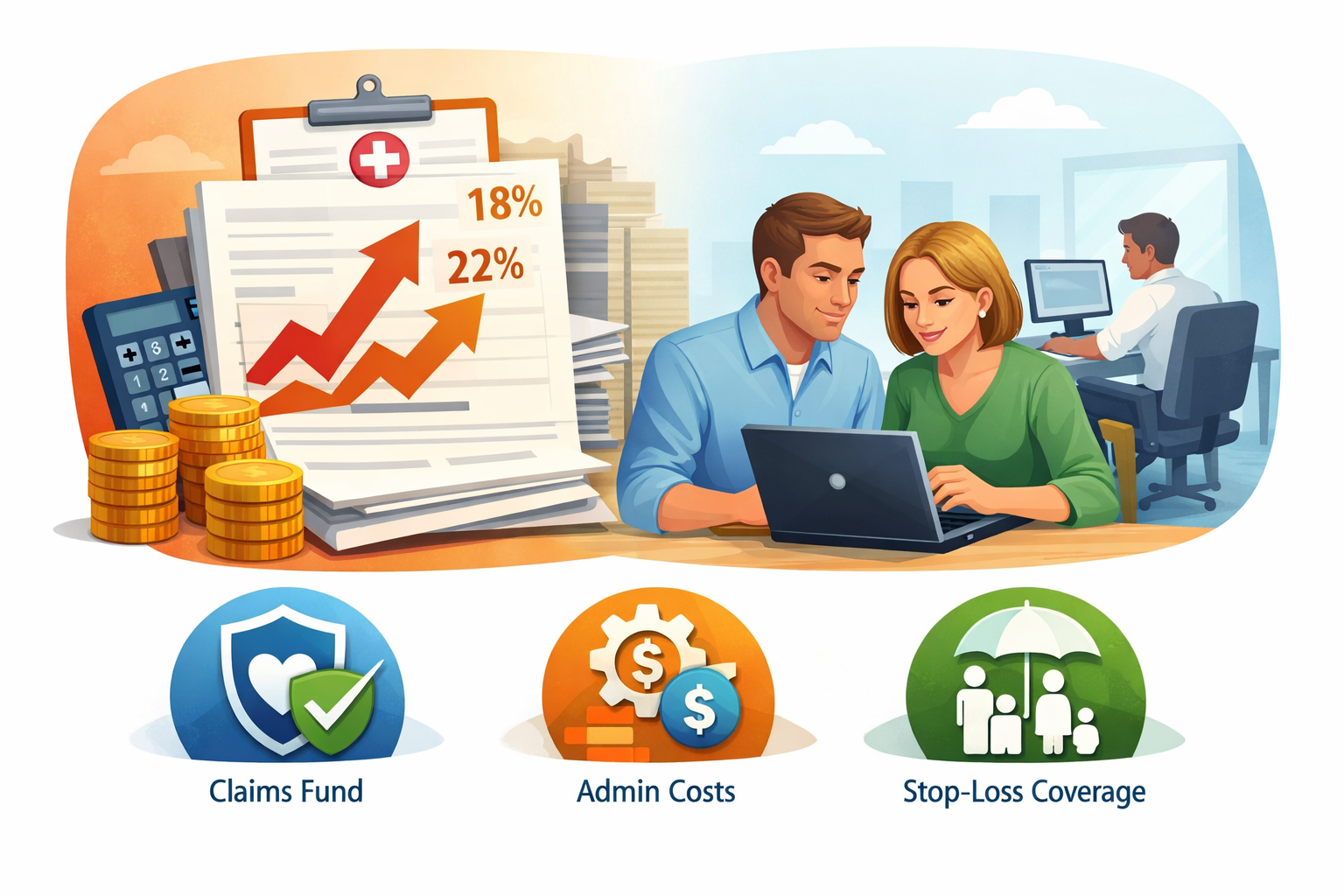
A hybrid: fixed monthly payments split into a claims fund, admin fee, and stop-loss. If claims come in under budget, you get a surplus refund — with downside capped by stop-loss. Best for 25–150 employees with below-average claims. Level-funded details → or read our small-business level-funded guide.
3. Self-Funded
You pay claims directly and keep 100% of the savings when utilization is low, with stop-loss insurance protecting against catastrophic years. Maximum transparency and control. Best for 100+ employees. Self-funded details →
4. Self-Funded Captive
Mid-size employers pool risk together in a group captive, capturing self-funded economics with shared protection against volatility. Best for 30–100 employees ready for transparency but wanting a safety net. Captive details → or our captive overview.
5. ICHRA (Individual Coverage HRA)
Instead of a group plan, you set a fixed monthly allowance and reimburse employees tax-free for individual market coverage. Predictable budget, no renewal surprises, works across states. ICHRA details → or see individual health plans.
6. PEO-Integrated
Health benefits bundled with HR administration and workers' comp through a PEO arrangement — pooled purchasing power and one administrative relationship. Works across multiple sizes. PEO-integrated details →
7. Taft-Hartley
A multi-employer trust structure, ERISA-protected, that aggregates risk across employers — often the deepest savings for unionized or trade workforces. Taft-Hartley details →
How to Choose
The honest shortcut: start with your headcount and claims history. The smaller and more risk-averse you are, the further toward fully-insured you sit; the larger and more claims-stable, the further toward self-funding you can move to capture savings. ICHRA and PEO cut across the spectrum when budget predictability or bundled administration matters more than risk-sharing.
Rather than guess, compare all seven side by side, then pressure-test your own numbers with the tools below.
Model It Before You Switch
Every path above changes your cost trajectory differently. Run your own scenario — free, no login, no email gate:
- Health Funding Projector — compare fully-insured, level-funded, and self-funded side by side
- Premium Renewal Stress Test — pressure-test your renewal increase
- Benefits ROI Calculator — translate benefits spend into outcomes
- Health Insurance Calculator suite — ACA affordability, COBRA, ICHRA, premium estimates
Frequently Asked Questions
What are the main health plan funding options for employers?
Seven common paths: fully-insured, level-funded, self-funded, self-funded captive, ICHRA, PEO-integrated, and Taft-Hartley. They differ in who carries the claims risk, how much cost transparency you get, and the employer size each fits best.
How do I choose the right health plan funding strategy?
It depends mainly on headcount, claims history, and risk tolerance. Smaller or risk-averse groups often start fully-insured or level-funded; mid-size groups with clean claims explore self-funded, captive, or ICHRA; larger groups move to self-funding. Model your scenario before deciding.
What size company does each funding path fit?
Rough guide: fully-insured 5–30, level-funded 25–150, self-funded captive 30–100, self-funded 100+, while ICHRA and PEO-integrated work across multiple sizes and states. Starting points, not hard rules.
Is Benefitra an insurance carrier?
No. Benefitra is an independent, payroll-agnostic, carrier-neutral brokerage. We compare funding paths and carriers on your behalf rather than steering you to a single product.
References
- Kaiser Family Foundation. "2024 Employer Health Benefits Survey." October 2024. kff.org
- Society for Human Resource Management. "Health Plan Funding Arrangements: Employer Guide." 2024. shrm.org
- U.S. Department of Labor. "ERISA Compliance Assistance: Health Benefit Plans." 2025. dol.gov
This overview is provided for educational purposes and does not constitute financial or legal advice. Consult your benefits advisor for guidance specific to your situation.
Comparing the seven funding paths
Most employers know their plan design but not the funding path underneath it, even though the funding path drives cost and risk more than the plan on top. From fully insured to level funded to self funded and pooled arrangements, each path carries a different balance of predictability, control, and savings.
Comparing the paths side by side, on your own census and spend, is how an employer stops defaulting and starts choosing. The right path is the one matched to your group, not the one you happened to inherit.
Key points:
- Fully insured for predictability
- Level funded for a fixed bill with surplus return
- Self funded with stop loss for control
- Pooled paths for smaller or contingent groups
For broader context, see KFF Employer Health Benefits Survey.
Compare the paths on your numbers in the Health Plan Cost Projector, then pressure-test next year with the Premium Renewal Stress Test.
Frequently asked questions
Why compare funding paths?
Because the funding path drives cost and risk more than the plan design. Comparing them is how you find the best value for your group.
Which path is best?
It depends on size, claims stability, and goals. Modeling all paths on your data is the reliable way to decide.
Can I switch paths?
Often, at renewal. Modeling the alternatives first shows whether a switch lowers cost or improves stability.