

In this article 9 sections
- Two documents can start the QMCSO process
- Separate clocks control the employer and plan response
- Private orders must pass four federal tests
- Standard NMSNs follow a fixed path
- Payroll withholding starts after the plan response
- Federal law bars four common enrollment refusals
- Coverage ends only after a permitted event
- Documentation makes each QMCSO handoff defensible
- Employer questions about QMCSOs
A child support notice reaches payroll on a Thursday afternoon. The employee says the child already has Medicaid. The plan has three medical options, the employee chose none, and the notice contains a custodial parent address that HR must not disclose.
This is not an ordinary dependent add.
A Qualified Medical Child Support Order, usually shortened to QMCSO, can require an employer health plan to cover a participant's child. The hard part is not the definition. It is moving the document among HR, the plan administrator, the carrier, payroll, and the issuing agency without missing a deadline or exposing protected family information.
This guide explains the federal workflow. State withholding priority and medical support rules still need review for the employee's work state.
Two documents can start the QMCSO process
A plan sponsor may receive either a private medical child support order from a court or state administrative process or a National Medical Support Notice. That document is an MCSO when it arrives. The plan administrator must test it against ERISA before calling it qualified.
The other path is a National Medical Support Notice, or NMSN, sent by a state child support agency, which is how the agency initially enforces the employee's medical support obligation through official notice to the employer. A properly completed NMSN is deemed to satisfy the federal QMCSO requirements. It comes in two parts. Part A goes to the employer. Part B goes to the plan administrator.
That distinction determines the next action. A private order follows the plan's written qualification procedure. An NMSN follows the standardized response path and fixed business day clocks. The Department of Labor QMCSO guide explains both routes and treats the child named in a qualified order as an alternate recipient with beneficiary rights under the plan.
Start by identifying who serves as plan administrator. The plan administrator designated in the plan document controls the handoff, and if none is designated the employer, labor organization, or association maintaining the plan may fill that role. It may be the employer, a carrier, a third party administrator, or a PEO. The answer depends on how the employer health plan is funded and administered, not on which inbox received the notice.
Separate clocks control the employer and plan response
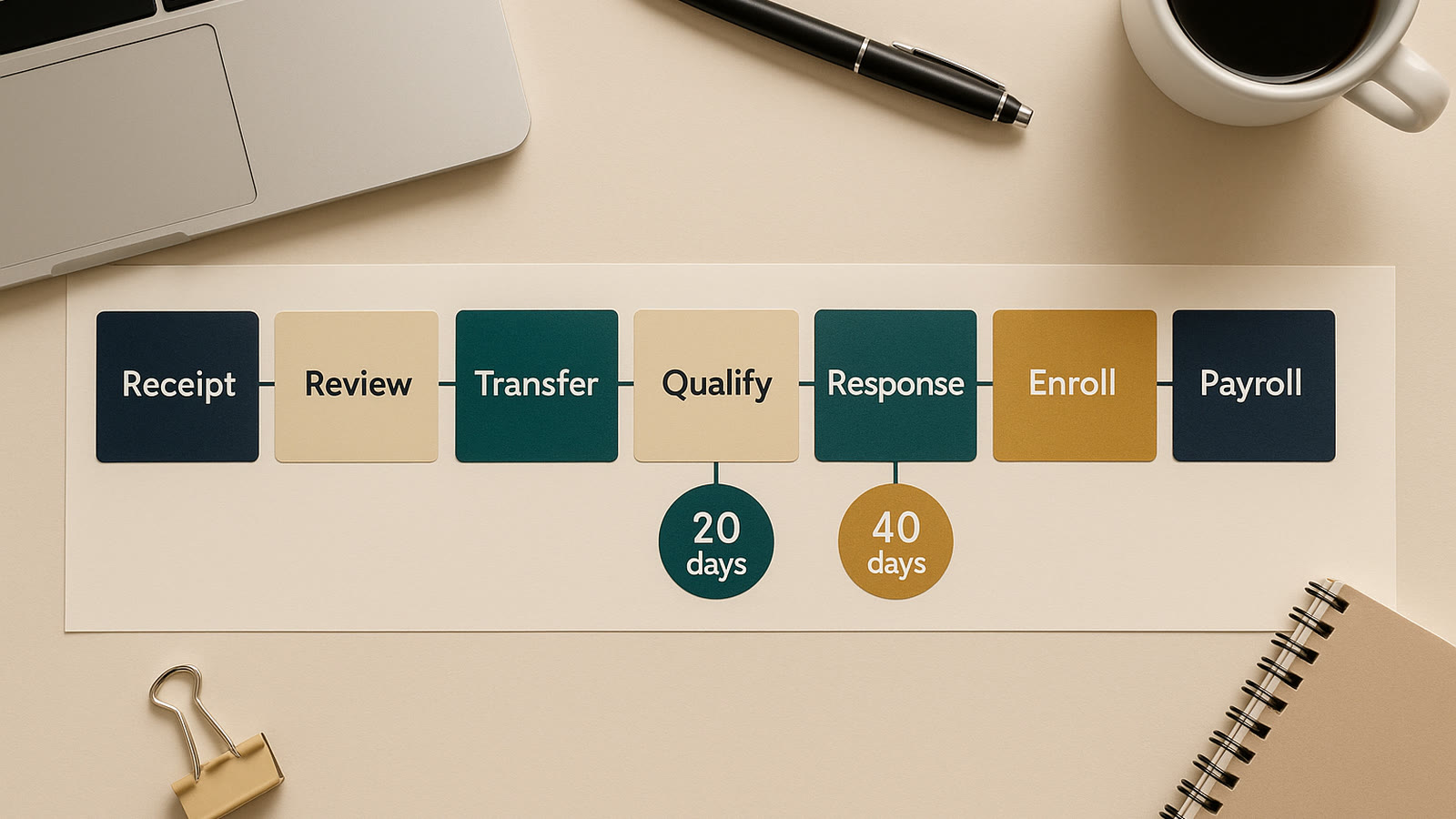
The employer and plan administrator do not share one deadline. When the employer or plan sponsor receives an NMSN, the employer must act on Part A for an applicable exception or transfer Part B to the appropriate group health plan within 20 business days.
The plan administrator then has 40 business days after that same notice date to complete and return its response to the issuing agency, or less time when a reasonable response is possible. The second clock does not restart when HR forwards the document.
Create the case record on receipt, and promptly notify the issuing agency if the employee terminates employment during processing. Record the notice date, actual receipt date, issuing agency, employee, plans that may apply, employer response due date, plan response due date, and person who owns each handoff. Keep the custodial parent and child details in a restricted file.
The federal NMSN employer rule creates the 20 business day transfer duty and requires the employer to continue withholding during an employee contest until the employer receives notice that the contest is resolved. The DOL guide cited above reproduces the plan response, coverage details, notices, and privacy instructions, and the plan administrator informs the agency through its response because these timing duties arise under state or federal law.
Private orders must pass four federal tests
A private court or agency order is not automatically a QMCSO. ERISA requires it to clearly provide four things.
- The participant's name and last known mailing address, plus the name and mailing address of each alternate recipient or a permitted substitute address
- A reasonable description of the health benefits or health care coverage to provide, or a way to determine such coverage
- The period to which the order applies
- Each group health plan to which the order applies
The order cannot require a benefit type, plan option, or coverage option that the plan does not offer, except where a state medical support law requires the plan to provide coverage. The plan must also maintain written procedures for reviewing orders and must notify the participant and each alternate recipient promptly after receipt.
Those requirements come from ERISA section 609. They also explain why HR should not approve or reject a private order from a quick reading. Route it through the plan's written procedure, keep proof of notice, and document the qualification decision.
That record belongs with the employer's broader ERISA fiduciary administration file, even when a vendor performs the review.
Standard NMSNs follow a fixed path
An appropriately completed NMSN is different: for enrollment of a dependent child under a group health plan, federal regulation treats it as a qualified medical child support order when it names the issuing agency, identifies the participant and alternate recipient, provides the required addresses or permitted substitutes, identifies the underlying order, and points to available coverage.
A missing child Social Security number is not one of the federal disqualifying elements. A missing address also does not defeat the notice when the address is reasonably accessible. If the agency does not designate a benefit type, the employer and administrator should treat all available group health coverage as designated.
When several options are available and the employee is not enrolled, the plan sends the options and contribution amounts to the agency so it can choose the dependent coverage or child's coverage to apply. The agency selects the coverage. If it does not respond within 20 business days after the plan response, the child goes into the plan's default option if one exists. If the employee refuses to sign enrollment materials, that does not stop enrollment under a valid notice.
The federal NMSN regulation supplies those rules. It turns a dense form into a practical instruction. Do not wait for the employee to choose, and do not invent a rejection reason that federal law does not recognize.
Payroll withholding starts after the plan response
The plan administrator determines available coverage and sends the enrollment information back to the employer. Payroll then decides whether to withhold employee contributions from the employee's pay after that information is received, subject to federal and state limits and priority rules.
There is no safe national percentage for every case. The employee's work state may control the priority among current support, arrears, and medical premiums, and payroll must apply federal withholding limits before any medical child support withholding can provide coverage through deductions. When wages cannot support the deduction, the employer should follow the issuing agency instructions rather than quietly cancel coverage or reduce another obligation.
An employee objection does not suspend the process. The employee must use the dispute route stated by the issuing agency, and the employer continues unless that agency directs a change. When coverage requires employee premium deductions, verify whether those deductions sit inside the employer's Section 125 cafeteria plan and confirm the payroll code with the plan and tax administrator.
The DOL guide cited above also addresses the difficult case where withholding limits prevent collection. The plan is not required to extend health insurance if required employee contributions cannot lawfully be withheld, but those amounts may still be adjusted through agency action or employee authorization.
Federal law bars four common enrollment refusals
Once the notice qualifies, ordinary enrollment habits do not control. The child cannot be denied because of any of these facts.
- The child was born outside marriage
- The participant does not claim the child as a federal tax dependent
- The child lives away from the participant or outside the plan service area
- The child receives or may receive Medicaid
The plan may also need to enroll the employee when employee enrollment is necessary to cover the child. Annual open enrollment restrictions do not block that action. The Department of Labor QMCSO guide states these rules directly.
Do not confuse QMCSO rights with the plan's ordinary dependent eligibility standards. The order can create rights for an alternate recipient even when the employee would not have added that child voluntarily. The plan still applies its terms to similarly situated dependents, but it cannot use the four prohibited grounds to refuse the ordered enrollment.
Coverage ends only after a permitted event
Enrollment is not permanent, but payroll cannot stop it because the employee requests a change. The plan needs an allowed event and the evidence required for that event.
Under the federal NMSN rule, the plan administrator cannot eliminate coverage unless it receives satisfactory written evidence that the order is no longer in effect, that the child has or will have comparable replacement coverage, or that another permitted event applies. It may also end if the employer eliminates family health coverage for everyone. When continuation rights apply, coverage can end if they are not elected or once the continuation period expires.
A child also ceases to qualify when similarly situated dependents are no longer eligible under the plan terms. That conclusion should come from the plan administrator, not from a payroll assumption about age, residence, or tax status.
The National Medical Support Notice regulation defines these stop events. If employment ends or another event creates continuation rights, coordinate the order closeout with the employer's COBRA administration process so continuation coverage is handled before the child's coverage is closed out, notify the issuing agency as required, and retain proof.

Documentation makes each QMCSO handoff defensible
One folder should let a reviewer reconstruct the case without opening an employee's general personnel file. Keep only what the plan and employer need, and restrict access to the people administering coverage and payroll.
The file should contain the following records.
- The complete order or NMSN as received
- The notice date and receipt date
- The plan's written QMCSO procedures
- Notices sent to the participant and alternate recipient
- The qualification decision and its supporting plan terms
- The employer Part A response or proof that Part B reached each affected plan
- The plan administrator response and coverage materials, including coverage documents applicable and medical management documents applicable after enrollment
- The effective date and enrollment confirmation, including the child's address used for delivery to the child's custodial parent when applicable
- The payroll contribution review and agency communications
- Any later termination evidence and closeout notices
Strong plan administration records support each handoff and help show who received post-enrollment materials.
The Department of Labor QMCSO guide says plans must maintain written procedures for determining whether orders are qualified and for administering them. A clean case file proves that the procedure operated, not merely that a policy existed.
Employer questions about QMCSOs
QMCSO meaning for group health plans
A QMCSO is a medical child support order that creates or recognizes a child's right to benefits under a parent's group health plan and satisfies the federal qualification requirements. The child becomes an alternate recipient and a beneficiary under the plan. A private order must be reviewed under the plan's written procedures. A properly completed National Medical Support Notice follows a standardized federal path and is deemed qualified. The statutory definition appears in ERISA section 609.
Employer action after a National Medical Support Notice
After a National Medical Support Notice arrives, the employer reviews Part A first, while the plan sponsor or employer determines where Part B should be routed. If an exception applies, such as the person never having worked there, the employer returns Part A to the issuing agency. Otherwise, it sends Part B to the plan administrator designated for the health plan within 20 business days after the notice date. The employer should calendar the plan's 40 business day response deadline at the same time because the second clock runs from the notice date, not from the transfer date. The DOL QMCSO guide explains the employer handoff. If there is any legal uncertainty about who should handle the notice, the plan's legal advisor should review that routing question.
Employee refusal cannot block a valid order
No. Once the order qualifies, employee consent is not required and open enrollment restrictions do not apply. If the plan requires employee enrollment before a dependent can enroll, the plan may need to enroll both. The employee can use the issuing agency's dispute process, but the employer should not pause or reverse enrollment without agency direction. The DOL QMCSO guide describes mandatory enrollment.
Insufficient wages may limit premium withholding
Payroll must apply federal withholding limits to the employee's pay before it can withhold employee contributions for the child's health coverage. If the available pay cannot support the required contribution, the employer should promptly notify the issuing agency rather than assume priorities under state or federal law. Do not assume medical premiums outrank current support, or the reverse, because priority rules vary. The custodial parent or agency may be able to modify the cash support allocation, and the employee may be able to authorize an amount otherwise permitted so the employer can provide coverage if allowed. The DOL compliance guide addresses insufficient withholding.
Expiration depends on the order and coverage events
The order should state the period to which it applies. The plan cannot eliminate coverage unless the order is no longer effective and the plan receives satisfactory evidence, comparable replacement coverage starts, the employer eliminates family coverage for all employees, or applicable continuation coverage is not elected or expires. Ordinary requests from the employee are not enough. The federal regulation lists the permitted coverage end events.
Divorce decrees need federal qualification
No. A divorce decree or other private domestic relations order must create or recognize the child's benefit rights and meet the four federal content requirements. The plan administrator applies the plan's written review procedures and notifies the participant and alternate recipient of its decision. A properly completed National Medical Support Notice is different because federal law deems it qualified. This article is an educational notice and does not constitute legal advice on unusual private orders or your employees obligations. The Department of Labor guide distinguishes private orders from NMSNs.
This article provides general federal compliance information, not legal or tax advice. Employers should confirm state withholding rules and unusual orders with qualified ERISA counsel or the issuing child support agency.
About the author
Samuel Newland, CFP, advises mid market employers on benefit design, compliance, payroll treatment, and workforce communication at Benefitra.
This article provides general federal compliance information, not legal or tax advice. Employers should confirm state withholding rules and unusual orders with qualified ERISA counsel or the issuing child support agency.