
In this article 9 sections
- Taxable fringe benefits run three separate tests, not one
- Six numbers changed for 2026
- Two exclusions ended, and one deduction disappeared
- Cash and gift cards are never de minimis, whatever the amount
- Group term life above $50,000 creates a monthly payroll entry
- Achievement awards fail on the plan, not on the gift
- The special accounting rule gives payroll a two month shift
- Employer paid AI training now qualifies as a working condition benefit
- What to do before the next payroll close
Most explanations of taxable fringe benefits stop at a two column list. Taxed on the left, not taxed on the right. That list is where the errors start, because a single benefit can be exempt from income tax withholding and still owe Social Security, Medicare and federal unemployment tax. Read one column, stop there, and the W-2 problem surfaces in January.
The 2026 edition of Publication 15-B was last reviewed on April 30, 2026. It changed more than usual. Two exclusions were removed permanently by P.L. 119-21. One limit rose by half. A new category appeared that did not exist in any prior edition. Any handbook, payroll manual or benefits summary written before this spring now quotes at least one wrong number, which can distort employer and employee tax liability, benefits administration, and year-end cost forecasts.
What follows is built for payroll teams, HR leaders, and finance leaders at growing employers with roughly 20 to 250 employees who have to classify benefits correctly and get year-end payroll right. It works through what moved, what the numbers actually are, how 2026 payroll tax treatment changes across income tax withholding, FICA, and FUTA, where timing and classification go wrong, what to know about the new AI training benefit, and the four places a mid-market team is most likely to book a benefit incorrectly.
Taxable fringe benefits run three separate tests, not one
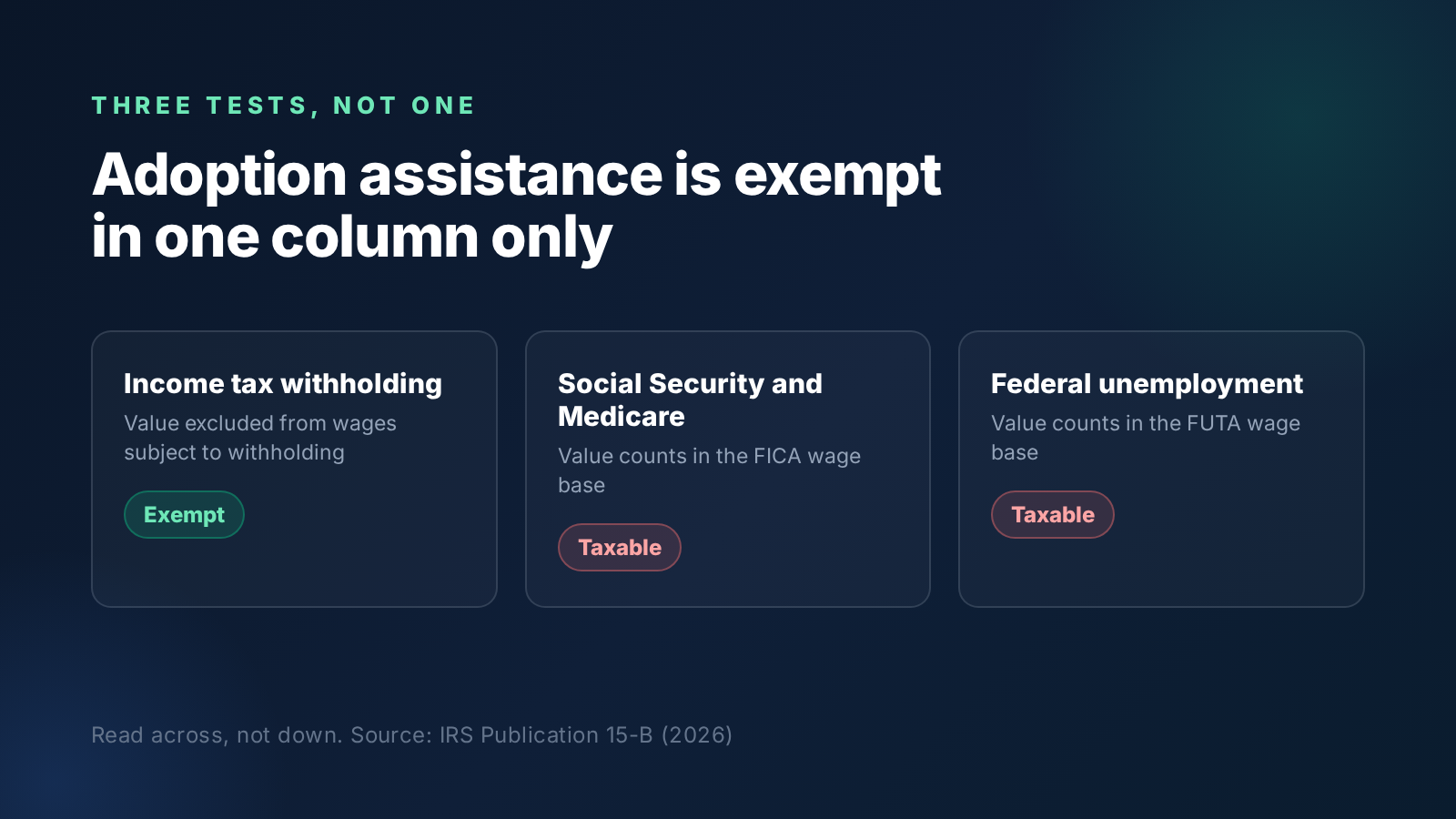
A fringe benefit is not simply taxable or exempt. Publication 15-B scores each benefit three times over. Income tax withholding. Social Security and Medicare. Federal unemployment tax. A benefit can clear one column and fail another. When it is taxable, the fair market value determines the taxable amount, and the IRS generally requires that amount to be included in the employee's gross income. When a benefit is taxable, its fair market value is reported on Form W-2.
Adoption assistance is the sharpest example. Income tax withholding treats it as exempt. Social Security, Medicare and federal unemployment tax all treat it as taxable. Treat it as a tax free benefit because the first column says exempt, and wages are underreported in two places.
The same structure explains why accident and health benefits are exempt in all three columns while a taxable noncash benefit like personal use of a company car is not. Read across, not down.
Employers that already run a Section 125 cafeteria plan for payroll tax savings will recognize the pattern, because the same three column logic governs which salary reductions actually reduce the FICA base.
Six numbers changed for 2026
The figures below come from the 2026 edition. Each one differs from what a 2025 handbook says, or from what most published summaries still show.
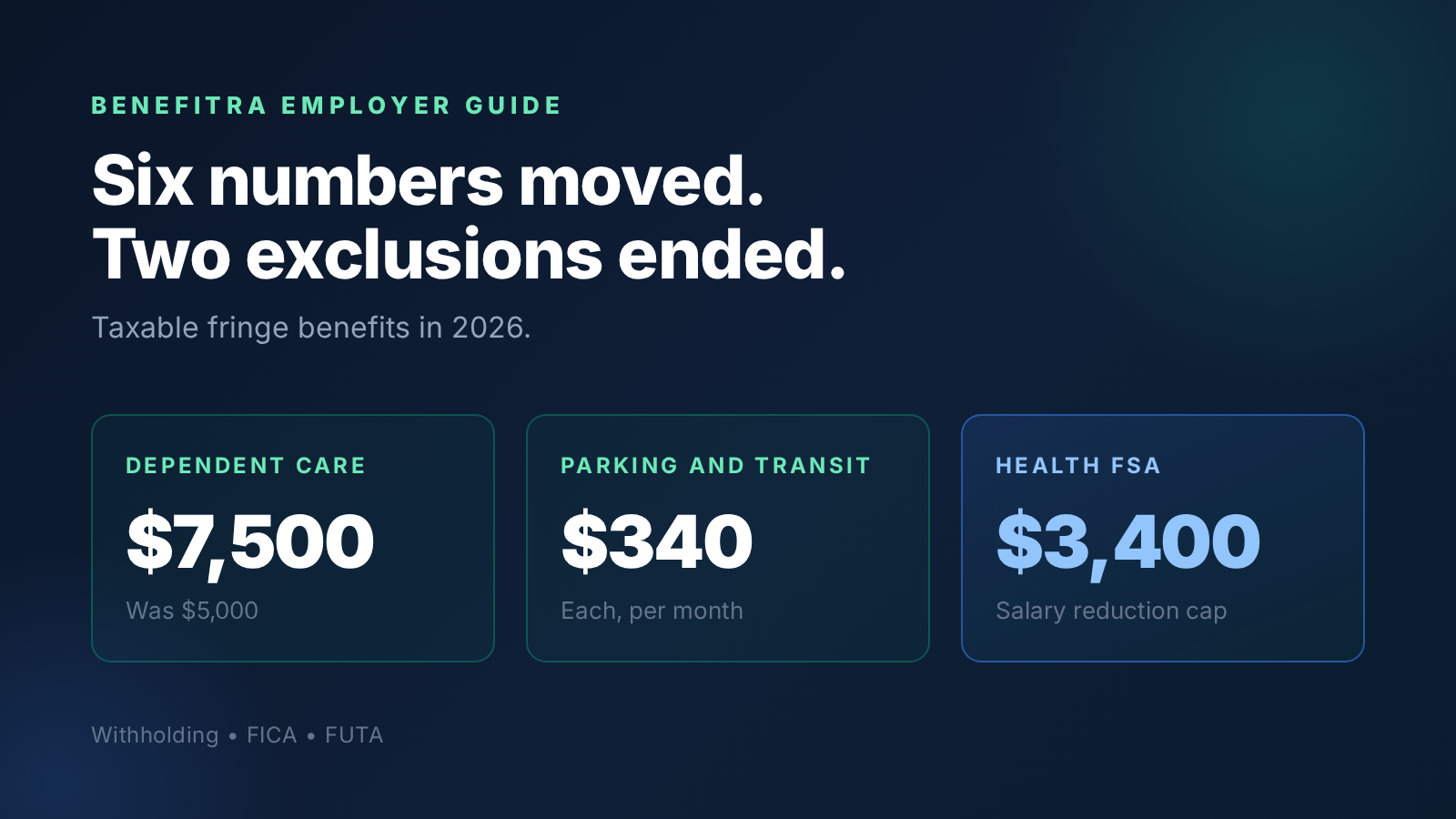
Dependent care assistance rose from $5,000 to $7,500. For a married employee filing a separate return, the limit went from $2,500 to $3,750. No other figure moved this far, and none is more likely to be quoted wrongly, because $5,000 held for decades. Employers running a dependent care FSA in 2026 should confirm the plan document was amended rather than assume the higher limit applies automatically.
The health FSA salary reduction limit is $3,400 for plan years beginning in 2026. A cafeteria plan may not allow an employee to request contributions above that amount.
Qualified parking is excludable up to $340 a month. Commuter highway vehicle transportation and transit passes are also excludable up to $340 a month. The two limits are equal this year, which removes a planning distinction that existed in earlier years.
Educational assistance stays at $5,250 a year, and it can include tuition, books, and fees, including graduate-level courses. P.L. 119-21 made that exclusion permanent for employer payments of student loans made after 2025. Amounts above $5,250 become taxable income unless the excess separately qualifies as a working condition benefit. Benefit design here is settled rather than waiting on an expiry date.
Achievement awards stay excludable up to $1,600 for qualified plan awards. Awards outside a qualified plan stop at $400.
Group term life insurance stays excludable up to the cost of $50,000 of coverage.
The business mileage rate for 2026 had not been published when the IRS released this edition. Employers using the cents per mile rule need that figure before valuing personal use of a company vehicle.
Two exclusions ended, and one deduction disappeared
P.L. 119-21 permanently eliminated the exclusion for qualified moving expense reimbursements. The exclusion survives only for a member of the Armed Forces on active duty moving under a permanent change of station, and for an employee or new appointee of the intelligence community who relocates under a change in assignment. For every other employer, a relocation payment is wages.
The same law ended the bicycle commuting exclusion too. That removal is permanent, for tax years beginning after 2025.
Separately, for amounts incurred or paid after 2025, an employer can no longer deduct the cost of food and beverages provided through an eating facility that meets the de minimis requirements or that operates for the convenience of the employer. That 50 percent deduction applied through 2025. A scheduled change from the 2017 Tax Cuts and Jobs Act removed it. The benefit can still be excludable from the employee's wages. What the employer loses is the deduction. Different question, different line on the return.
The supplemental wage withholding rate stays at 22 percent. Past $1 million of supplemental wages to one employee in a calendar year, the rate is 37 percent.
Cash and gift cards are never de minimis, whatever the amount
A de minimis benefit is property or a service of so little value, taking account of how often similar benefits are provided, that accounting for it would be unreasonable or administratively impracticable. There is no dollar threshold in the publication. Frequency is part of the test.
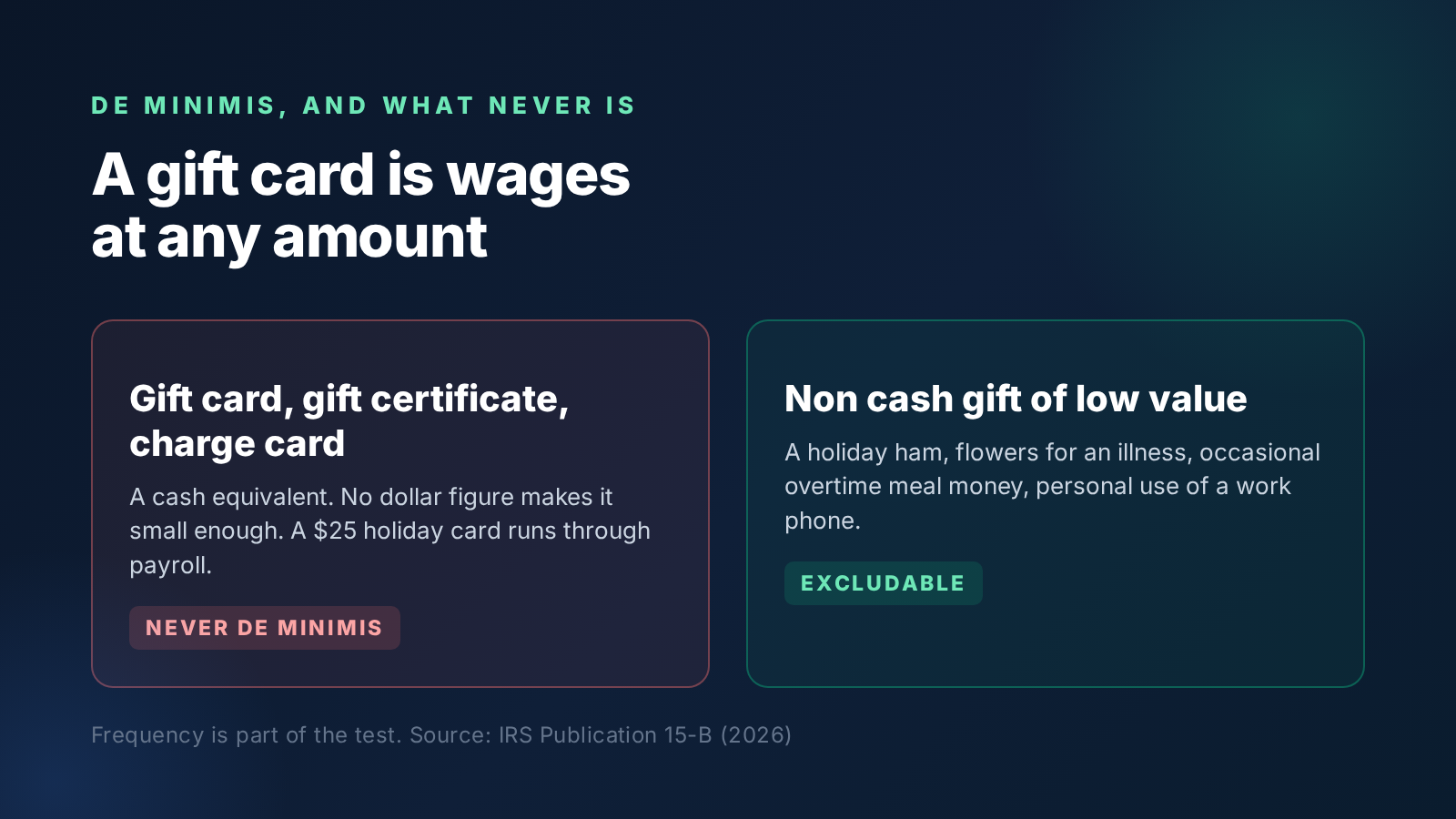
The hard rule sits in the next sentence of the regulation. Gift certificates, gift cards and the use of a charge card or credit card count as cash equivalents, and no cash equivalent is ever excludable as a de minimis benefit, however small. A $25 gift card at the holidays is wages. Employers get this wrong more than anything else in the publication, and the rule leaves no room to argue.
Two narrow exceptions exist. Meal money and local transportation fare may be excluded when provided on an occasional basis and because of overtime work.
Benefits that do qualify include personal use of an employer provided cell phone supplied primarily for noncompensatory business reasons, occasional personal use of a company copier where the employer controls use so that at least 85 percent of it is for business, and holiday or birthday gifts other than cash with a low fair market value. Flowers or fruit provided because of illness, a family crisis or outstanding performance also qualify.
Group term life above $50,000 creates a monthly payroll entry
Coverage up to the cost of $50,000 is excludable. Past that point, the excess is valued with Table 2-2 in the publication and added to wages.
Two details catch employers out. When coverage above $50,000 continues after an employee terminates, including for retirees, the former employee pays their share of Social Security and Medicare tax with their own tax return. Collection is not required, but the employer share is still owed, and the uncollected amounts go separately in box 12 of Form W-2 under codes M and N.
The second is the key employee rule. If the plan favors key employees as to participation or benefits, the entire cost of the insurance goes into those employees' wages, not merely the amount above $50,000. Church plans are generally outside this rule.
Dependent coverage has its own threshold. Coverage on an employee's spouse or dependent is treated differently once the face amount exceeds $2,000, and above that it is excludable only if the excess cost over what the employee paid on an after tax basis is small enough that accounting for it is unreasonable or administratively impracticable. Employers reviewing plan design will find the mechanics in Benefitra's group term life insurance guide for employers.
Achievement awards fail on the plan, not on the gift
The $1,600 limit applies to qualified plan awards. A qualified plan award is one given under an established written plan or program that does not favor highly compensated employees as to eligibility or benefits. Without that written plan, the ceiling drops to $400.
Highly compensated here means one of two things: a 5 percent owner at any point in the year or the year before, or pay above $160,000 for the preceding year. That pay test may be disregarded where the employee was not also in the top 20 percent of employees ranked by pay for the preceding year.
The deduction limit mirrors the exclusion: $400 for awards that are not qualified plan awards, and $1,600 for all awards to any one employee in the tax year.
Service awards handed out without a written program are not a $1,600 benefit. It is running a $400 one, and the excess is wages.
The special accounting rule gives payroll a two month shift
The value of taxable noncash benefits can be treated as paid on a pay period, quarterly, semiannual or annual basis, provided it is treated as paid at least once a year.
The useful part is the timing election. Taxable noncash benefits provided during the last two months of the calendar year, or any shorter period inside those two months, may be treated as paid in the next year. The value of benefits actually provided in November and December of 2025 could be reported with the first ten months of 2026.
The rule is narrower than it first appears. Only benefits actually provided in those last two months qualify. It cannot be used to defer a full year of benefits, and it does not apply to a transfer of tangible or intangible personal property of a kind normally held for investment.
For an employer valuing personal use of company vehicles at year end, this election decides which W-2 the amount lands on. Document the choice and apply it consistently, rather than leaving it to whoever closes December payroll.
Employer paid AI training now qualifies as a working condition benefit
This category is new in the 2026 edition. Following Executive Order 14179 in January 2025 and the AI Action Plan published in July 2025, the IRS states that employer provided AI literacy and skill development programs may be tax free as working condition fringe benefits where they maintain or improve employee job skills in the employee's current role.
The condition is the same one that governs every working condition benefit: it is tax-free only when it would otherwise be a business expense and one of the employee's deductible business expenses. The training has to relate to the job the employee holds now. A course that qualifies an employee for a different role does not meet the test, and the treatment then falls back to educational assistance, with its own $5,250 ceiling. Other examples include business travel and company-provided devices.
For employers already funding technical training, this is a route that does not consume the educational assistance limit. Documentation is crucial to support the business purpose and job relationship when the program is approved, not reconstructed later.
What to do before the next payroll close
Pull the list of every noncash benefit paid this year and score each one across all three tax columns rather than a single taxable or exempt flag.
Check whether any gift card, gift certificate or charge card use has been treated as de minimis. If it has, it is wages and it needs correcting before year end rather than after.
Confirm the dependent care plan document reflects $7,500 and that payroll limits match the document. A plan that was never amended cannot pay the higher amount simply because the statute allows it.
Verify that relocation payments made this year were run through payroll as wages, since the exclusion is gone.
Decide in writing whether the special accounting rule will apply to November and December noncash benefits, and record who made that decision.
Review group term life coverage above $50,000 for terminated employees and retirees, and confirm box 12 codes M and N are set up in the payroll system.
Employers who want the payroll tax effect modeled rather than described can start with Benefitra's payroll tax savings calculator.
Frequently asked questions
Are all fringe benefits taxable?
No. The publication lists benefits exempt from income tax withholding, from Social Security and Medicare, and from federal unemployment tax, and the three columns do not always agree. This is part of how fringe benefits work within broader employee benefits rules, because certain fringe benefits, such as transportation benefits like transit passes, can be excluded when they meet the applicable limits. Accident and health benefits are exempt in all three. For adoption assistance, only the income tax withholding column says exempt, while some employee fringe benefits still count as taxable benefits in other cases, since fringe benefits are taxable when they do not qualify for an exclusion.
Is a $25 gift card a de minimis benefit?
No. Cash and cash equivalents including gift cards, gift certificates and charge card use are never excludable as de minimis benefits regardless of amount.
What is the dependent care limit for 2026?
$7,500, or $3,750 for a married employee filing a separate return. It was raised from $5,000 and $2,500 for the 2026 tax year.
Can an employer still reimburse moving expenses tax free?
Only for a member of the Armed Forces on active duty under a permanent change of station, or for a qualifying employee or new appointee of the intelligence community. For everyone else, P.L. 119-21 removed the exclusion permanently.
How much group term life insurance is tax free?
The cost of up to $50,000 of coverage. Above that, the employer values the excess using Table 2-2 and includes it in wages, and if the plan favors key employees the entire cost goes into their wages.
When is a health FSA contribution over the limit?
For plan years beginning in 2026, a cafeteria plan may not allow salary reduction contributions to a health FSA above $3,400.
About the author
Samuel Newland, CFP, advises mid-market employers on health plan funding, benefits compliance and payroll treatment at Benefitra.
This article is educational and is not legal, tax, payroll, or accounting advice. Confirm the treatment of any specific benefit with the payroll provider, tax adviser, or benefits counsel responsible for the filing.
Sources for this guide
- IRS Publication 15-B (2026), Employer's Tax Guide to Fringe Benefits: https://www.irs.gov/publications/p15b
- IRS Publication 15-B (2026), PDF edition: https://www.irs.gov/pub/irs-pdf/p15b.pdf