

In this article 8 sections
- A level funded plan is self insured under federal law because the statute turns on the words "any portion"
- KFF's own 2025 numbers show level funded employers are not being counted as self funded
- Your carrier's PCORI line item becomes your own excise tax return at $3.84 per covered life
- December 31 gag clause attestation stays your violation even after your TPA agrees to file it
- Prescription drug reporting states in its own text who violates the rule when a vendor fails
- Form 5500 usually stays put, and participant count plus general assets explains why
- What to confirm before you sign a level funded renewal
- Samuel Newland brings a financial planning lens to employer benefit decisions
Your carrier renewal came in high, your broker showed you a level funded quote, and the monthly number looked like the fully insured number with a refund attached. The plan design barely moved. The network stayed. On paper it reads as a funding tweak.
Federal law reads it differently. The moment any part of your claims is paid from company money rather than through an insurance policy, four federal filing duties stop belonging to your carrier and start belonging to you. Nothing in the quote says so, because the quote is about premium.
This is written for employers with roughly 20 to 200 enrolled employees who are looking at a level funded renewal for January, and for the finance person who will be the one signing the excise tax return.
A level funded plan is self insured under federal law because the statute turns on the words "any portion"
The classification question has a short answer, and it sits in the tax code rather than in a brochure.
Section 4376 of the Internal Revenue Code defines an "applicable self-insured health plan" as any plan providing accident or health coverage where "any portion of such coverage is provided other than through an insurance policy." Two words carry the weight. Not most. Not all. Any portion.
A level funded arrangement pays claims below the stop loss attachment point out of employer money. That portion is not provided through an insurance policy. The stop loss contract above the attachment point is insurance, and it does not convert the layer beneath it.
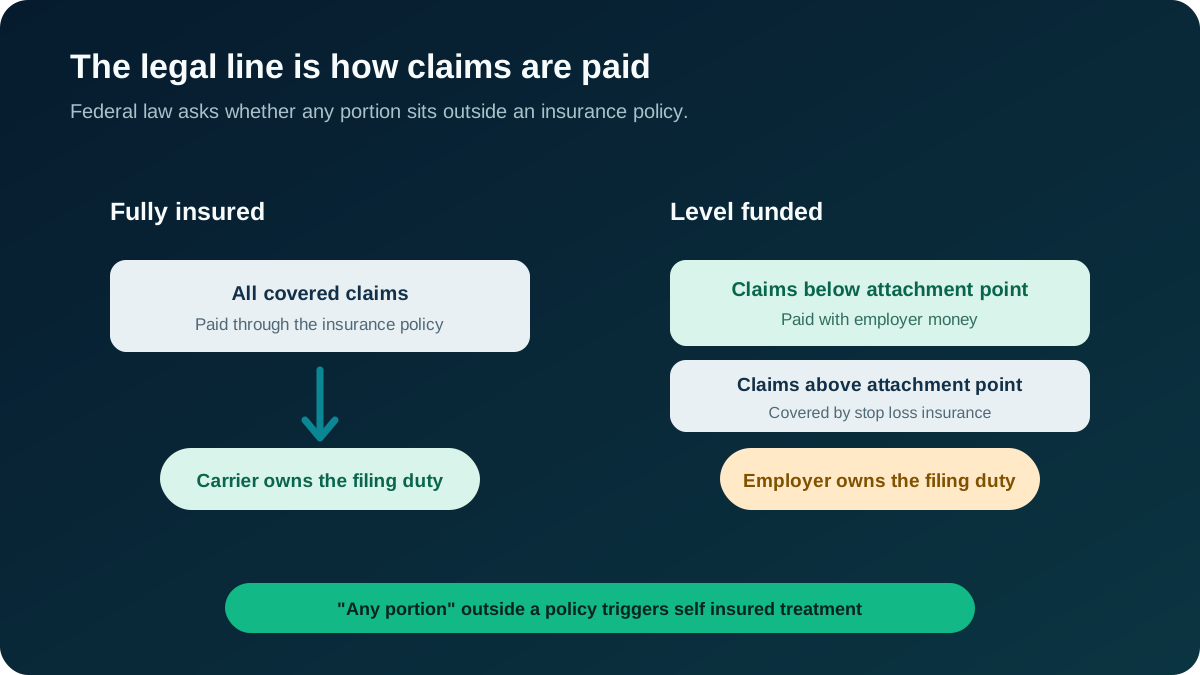
Market language and legal language point in opposite directions
KFF describes the arrangement in the same mechanical terms. Its 2025 survey calls level funded arrangements ones that "combine a relatively small self-funded component with stop-loss insurance, which limits the employer's liability and transfers a substantial share of risk to insurers," per the KFF 2025 Employer Health Benefits Survey. A small self funded component is still a self funded component, and section 4376 asks only whether one exists.
Attorney Seth F. Capper of Maynard Nexsen PC states the practitioner version plainly: "Because level-funded plans are considered self-funded for compliance purposes," the sponsor picks up the reporting set, and on prescription drug reporting "unlike with fully insured plans, self-funded plan sponsors are ultimately responsible for ensuring that RxDC reporting requirements are met, even if the plan's TPA or other third" party prepares the substance. That appears in his firm's note on the advantages and disadvantages of a level funded group health plan.
Employer facing summaries often say the opposite, and some of the most visible ones state that level funded plans count as fully insured for regulatory purposes. The statute does not support that reading.
KFF's own 2025 numbers show level funded employers are not being counted as self funded
Here is the part that makes this more than a definitional quibble, and it comes out of arithmetic rather than opinion.
The KFF 2025 Employer Health Benefits Survey, which collected responses from 1,862 firms between January 27 and July 23 of 2025, reports two figures for the same size band. Twenty seven percent of covered workers at firms with 10 to 199 workers are in plans KFF classifies as self funded. Thirty seven percent of covered workers at firms with that same headcount are in a level funded plan.
Thirty seven cannot sit inside twenty seven
If level funded plans were being counted within the self funded total, the level funded share could not exceed it. Thirty seven percent is larger than twenty seven percent, so the two are separate buckets in how employers report and how the survey tallies.
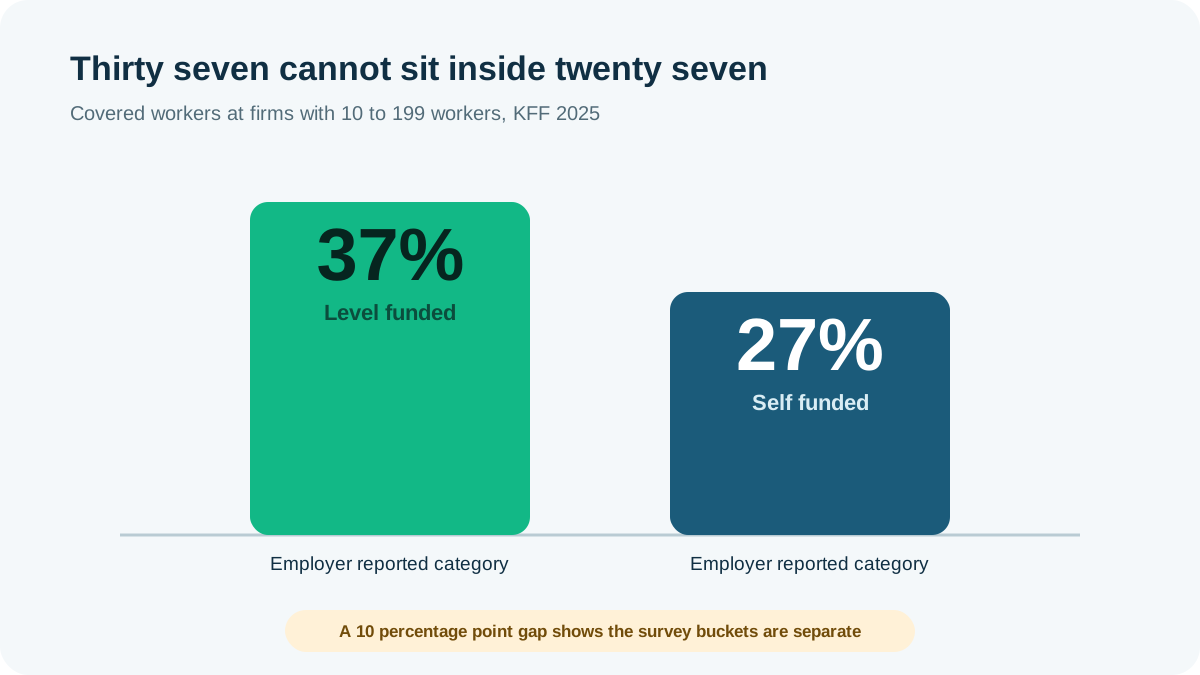
That produces an odd result. Among firms with 10 to 199 workers, the arrangement that federal law treats as self insured is now ten percentage points more common than the arrangement employers actually call self funded. Across all firm sizes KFF puts self funding at 67 percent of covered workers, and it reaches 80 percent at firms with 200 or more.
Your carrier's PCORI line item becomes your own excise tax return at $3.84 per covered life
The clearest financial handover is small in dollars and unambiguous in law.
Sections 4375 and 4376 impose the Patient Centered Outcomes Research Trust Fund fee on two different parties. For insurance policies the fee falls on the issuer. For applicable self-insured health plans, section 4376 says the fee "shall be paid by the plan sponsor," and defines the plan sponsor as "the employer in the case of a plan established or maintained by a single employer."
Current rate and the arithmetic behind it
IRS Notice 2025-61, published in Internal Revenue Bulletin 2025-45, sets the adjusted amount at $3.84 for policy years and plan years ending on or after October 1, 2025 and before October 1, 2026. The prior window was $3.47, so the per life figure rose about 10.7 percent.
The fee is that amount multiplied by the average number of lives covered during the year. A level funded plan covering 120 lives owes $460.80. One covering 400 lives owes $1,536.00.
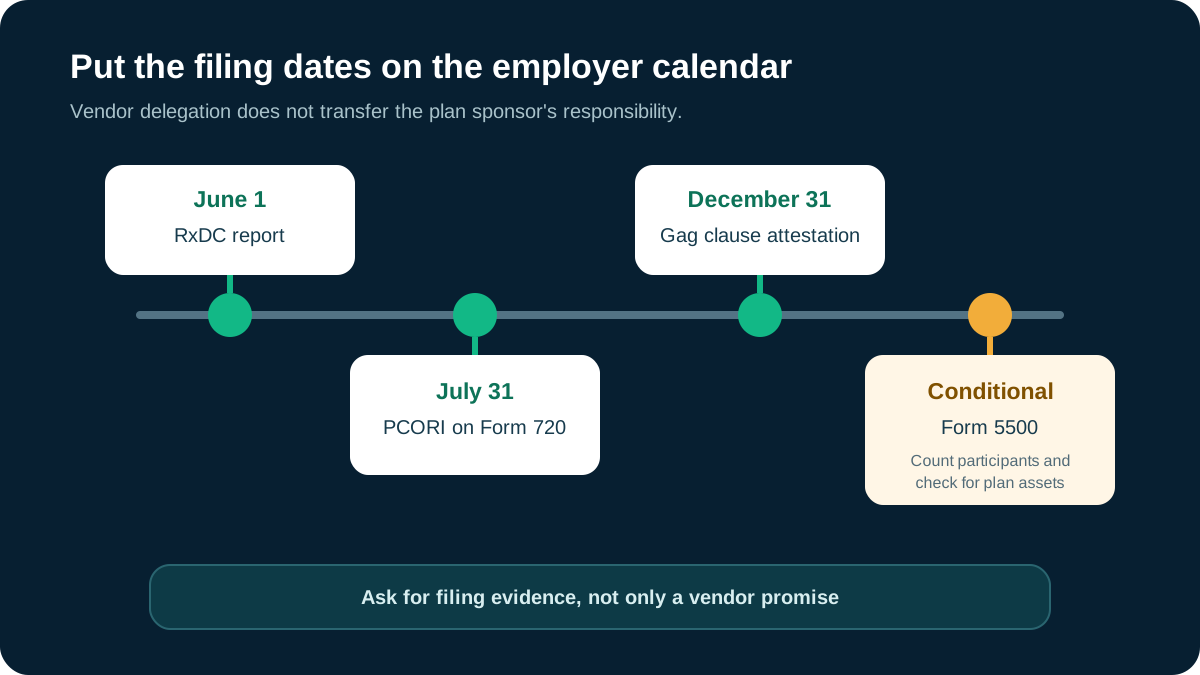
Payment goes on IRS Form 720 by July 31 of the year following the plan year, and the IRS guidance on who reports and pays the PCORI fee records no exemption for small plans. A twenty five life plan files. Benefitra's guide to the July PCORI deadline for construction employers walks the filing itself.
The dollars rarely matter. The excise tax return does, because most employers at this size have never filed one and no one sends a reminder.
December 31 gag clause attestation stays your violation even after your TPA agrees to file it
This is where delegation stops working, and the difference is written into the government's own instructions rather than inferred from them.
Every group health plan must attest annually that its contracts contain no gag clauses on cost and quality data. CMS confirms on its gag clause prohibition compliance attestation page that after the first filing, "Responsible Entities must attest annually by December 31."
Insured plans get a safe harbour, self funded plans get a written agreement
The federal annual submission instructions treat the two funding types differently in consecutive paragraphs. Where a fully insured plan's issuer attests, "the Departments will consider both the plan and issuer to have satisfied the attestation submission requirement."
A self funded plan may also hand the job to a third party administrator. The instructions then close the door: "such a written agreement does not, by itself, satisfy the self-funded plan's attestation requirement. If a self-funded plan chooses to enter into such an agreement and a TPA fails to submit the plan's attestation to the Departments as required, the plan violates the requirement to provide an attestation of compliance."
Read that against a level funded renewal. The carrier attesting on behalf of your old fully insured plan discharged you. The administrator attesting on behalf of your new level funded plan does not. Benefitra's gag clause attestation guide for employers covers the submission itself and how to confirm a vendor actually filed.
Prescription drug reporting states in its own text who violates the rule when a vendor fails
Prescription drug reporting makes the same distinction, and unusually the regulation states the consequence in words rather than leaving it to enforcement practice.
45 CFR 149.720 sets the deadline first: beginning with the 2021 reference year, "the report for each reference year is due by June 1 of the year following the reference year."
One paragraph shields the insured employer and the next one does not shield you
Paragraph (d)(1) covers insured coverage. If the plan requires its issuer to report under a written agreement and the issuer fails, "then the issuer, but not the plan, violates the reporting requirements."
Paragraph (d)(2) covers everyone else, such as third party administrators and pharmacy benefit managers. If the plan enters such an agreement "and the party with which it contracts fails to provide the information," then "the plan or issuer violates the reporting requirements."
Same filing. Same vendor failure. The insured employer is named as protected and the self funded employer is named as liable, four lines apart. Benefitra has written separately on recovery steps after a missed RxDC filing, which is a more common situation than the deadline's obscurity suggests.
Form 5500 usually stays put, and participant count plus general assets explains why
Guidance on this one is frequently wrong in the employer's favour, which is worse than being wrong against it.
A widely repeated shortcut says self funded plans file Form 5500. The exemption at 29 CFR 2520.104-20 is narrower and more useful than that. It relieves a welfare plan from filing an annual report where the plan "covers fewer than 100 participants at the beginning of the plan year" and benefits "are paid as needed solely from the general assets of the employer," or are provided exclusively through insurance, or both.
Where the exemption holds and where it breaks
A level funded plan below 100 participants that pays claims from company general assets and holds no trust generally sits inside that exemption. Crossing 100 participants at the start of a plan year ends it, and the plan then files as a self insured welfare plan.
Establishing a trust to hold plan money also breaks it, at any headcount, because the plan is no longer paying solely from general assets. Employers sometimes create one on advice given for a different reason entirely.
Although self-funded insurance plans are generally governed by federal regulations rather than state insurance regulations, group size still interacts with state rules because state minimum attachment points decide whether a small employer can buy the stop loss layer a level funded plan depends on. Benefitra's research on state stop loss rules for small employers and the analysis of minimum group size for self funded and level funded plans cover that layer.
What to confirm before you sign a level funded renewal
Five questions, asked before signature rather than after the first deadline passes.
- Get the administrator's gag clause commitment in a written agreement, and diarise a December check that the attestation was actually submitted rather than promised.
- Ask which entity files the RxDC report by June 1, whether the administrator and the pharmacy benefit manager each cover their own files, and what evidence of submission you receive.
- Confirm who computes the average covered lives for the PCORI fee, and put the July 31 Form 720 filing on the finance calendar rather than the benefits calendar.
- Count participants at the first day of the plan year, and ask whether any trust is being established, because those two facts decide Form 5500.
- Ask what the stop loss attachment point is and whether your state's minimum permits it at your headcount.
Modelling the money side alongside the filing side is the point of the Health Funding Projector, which is free and needs no login. The wider comparison of arrangements sits in Benefitra's overview of six health coverage funding strategies for mid size employers, and the decision framing in moving from fully insured to self funded.
Frequently asked questions
Is a level funded plan fully insured?
No. The stop loss layer above the attachment point is insurance, but in a level funded insurance setup the fixed monthly amount is the plan cost, bundling expected claims, stop-loss protection, and administrative charges as fixed costs before stop loss insurance covers higher costs, while claims below that threshold are still paid from employer money, and that is what the law looks at. Section 4376 applies where "any portion" of coverage is provided outside an insurance policy, so the plan is self insured for federal purposes even though the monthly billing resembles a premium.
If claims run lower than expected and there are fewer claims than projected, unused claim dollars may be refunded at year-end, which can help control healthcare budgets and healthcare expenses, and level funded plans provide more predictable budgeting with often less administrative burden because the carrier or vendor usually handles claims processing and much of the compliance work.
Is a level funded plan self insured?
Yes, for federal compliance. Both KFF's survey definition and the Maynard Nexsen analysis cited above describe level funded arrangements as containing a self funded component, and section 4376 needs only that component to exist; a self funded health plan also usually offers more flexibility in plan design and healthcare benefits than a level funded health insurance arrangement. In practice, self funded health insurance and other self insured health plans are more common among larger employers because they take on direct responsibility for employee healthcare claims and broader healthcare costs.
Traditional self funding is more common among larger companies because the employer assumes more financial risk and financial responsibility than under level funding, making risk management more important when facing unexpected claims or catastrophic claims. Under the self funded model, monthly costs can change unpredictably as employer funds are used to pay employee health claims, employee claims, and other medical claims based on actual claims and medical care utilization in a self insured plan, which can cause swings in medical costs and overall healthcare expenses. Some state insurance rules treat the arrangement differently, which is why a plan can be self insured federally and still be shaped by state stop loss law.
Who pays the PCORI fee on a level funded plan?
Plan sponsors in single-employer arrangements are the employer for this purpose. Section 4376 assigns the fee to the plan sponsor and names the employer for a single employer plan. The rate is $3.84 per covered life for plan years ending on or after October 1, 2025 and before October 1, 2026, filed on Form 720 by July 31 of the following year. There is no small plan exemption.
If my TPA files the gag clause attestation, am I covered?
Not in the way a carrier's attestation covered you when you were fully insured. CMS instructions state that a written agreement "does not, by itself, satisfy the self-funded plan's attestation requirement," and that if the administrator fails to submit, "the plan violates the requirement." Keep the agreement and verify the filing before December 31, even if the third-party administrator is handling administrative services for the plan, because the employer remains responsible if the filing is missed.
Do level funded plans have to file Form 5500?
Only sometimes. A plan with fewer than 100 participants at the start of the plan year that pays benefits solely from the employer's general assets falls inside the exemption at 29 CFR 2520.104-20. At 100 or more participants, or where plan money is held in trust, the plan files.
What is the real difference between level funded and self funded?
Cash flow and risk transfer, not legal category: this is mainly a choice between types of health insurance plan funding among different funded health plans. A fully insured plan uses a fixed monthly premium through an insurance carrier, and the insurance company, not the employer, bears the claims risk in that model, while fully funded plans typically carry higher premiums than self funded insurance. Level funding fixes the monthly payment, with stop loss insurance costs and administrative fees built into that fixed monthly amount, which supports predictable budgeting and can create cost savings versus a fully insured plan when claims costs run well, while in a self insured plan the employer pays employee claims as they arise.
Level funded plans help small businesses manage health benefits with more predictable monthly costs and less financial risk, and providing healthcare benefits this way appeals to smaller employers partly because 34% of small firms used level-funded plans in 2023, compared with 18% using self-funded plans, while self funded insurance can produce substantial savings when actual claims are low but leaves the employer exposed to higher healthcare costs when claims spike. Federal reporting duties are the same in both because both pay some claims outside an insurance policy.
When is the RxDC report due?
June 1 of the year following the reference year, under 45 CFR 149.720. A report covering the 2026 reference year is due June 1, 2027.
Samuel Newland brings a financial planning lens to employer benefit decisions
Samuel Newland, CFP came to employee benefits from financial planning, and it shows in how he approaches plan design and funding. Fully insured, level funded, self funded, captive, ICHRA, PEO integrated, Taft Hartley. He founded Benefitra and works across all of them. Author profile: https://benefitra.com/samuel-newland/