Benefitra Video
Four Ways to Fund a Health Plan: The Portfolio You’re Really Choosing
Last updated
A calm, 3 minute 44 second explainer for business owners and finance leaders. It compares fully insured, level-funded, traditional self-funded and group-captive health plan funding by treating the plan as an investment portfolio.
- 3 min 44 s
- Captions
- 4 funding structures
- For owners, CFOs and HR
The video in three sentences
- What it compares
This Benefitra video uses an investment-portfolio analogy to compare four ways to fund an employer health plan: fully insured, level-funded, traditional self-funded and group captive.
- What it explains
It explains why a level monthly payment is not the same as a stable renewal, how healthier groups leaving the fully insured small-group pool can raise pressure on the groups that remain, and how a captive splits risk into an employer layer, a pooled layer and stop-loss.
- Where it lands
Its conclusion is that no structure is best for everyone, so employers should weigh expected cost, volatility, transparency and control rather than the lowest first-year quote.
The portfolio you are really choosing
Four Ways to Fund a Health Plan: The Portfolio You’re Really Choosing is a Benefitra motion-graphics video for business owners, CFOs and finance leaders. It treats a health plan as a portfolio and each covered life as one holding, then shows how each funding structure changes what the employer pays, what it can see and how much volatility it keeps.
The video is a planning framework, not a promise of savings or a guaranteed renewal outcome. It keeps the same large claim in every structure, so the difference you see is how that claim is financed, not a different group of people.
- Fully insured Portfolio analogy Treasury or high-grade bond fund Maximum risk transfer Lowest expected upside, not a guarantee. Watch from 0:23
- Level-funded Portfolio analogy High-yield bond fund More potential upside, more renewal risk Surplus and renewal outcomes are never guaranteed. Watch from 1:22
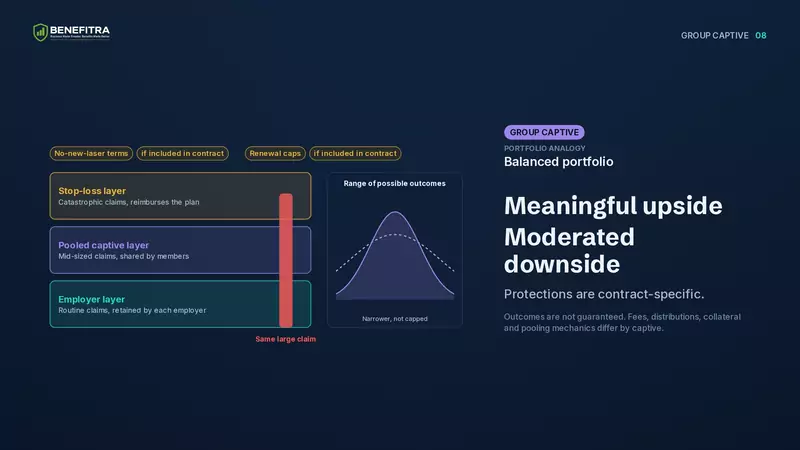
- Group captive Portfolio analogy Balanced portfolio Meaningful upside, moderated downside Protections are contract-specific. Watch from 2:33
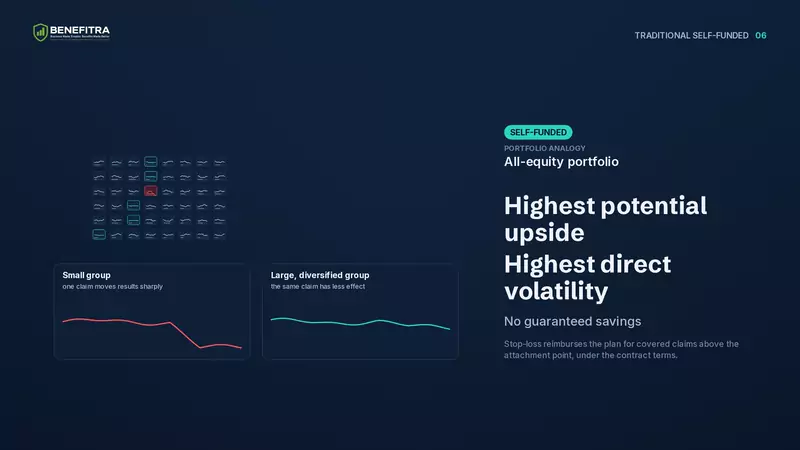
- Self-funded Portfolio analogy All-equity portfolio Highest potential upside, highest direct volatility No guaranteed savings. Watch from 1:50
Conceptually, expected upside rises as the employer retains more risk. But realized outcomes can reverse that order in any year.
What to take from it
Fully insured and the small-group pool
-
 0:23
Fully insured buys risk transfer and simplicity
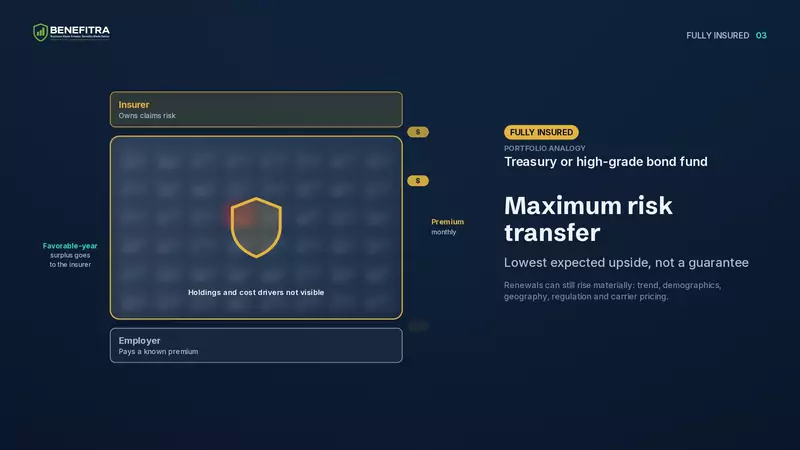
Fully insured behaves like a Treasury or high-grade bond fund. You pay a known premium and transfer claims risk to the insurer, and in favorable years the insurer keeps the upside. It usually offers the lowest expected savings participation, and renewals can still rise materially because of trend, demographics, geography, regulation and carrier pricing.
-
 0:43
Small-group pricing and credibility
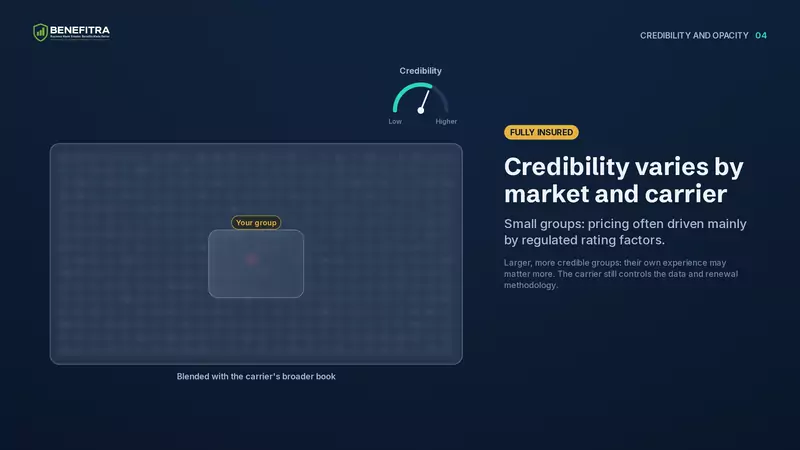
For small groups, pricing is often driven mainly by regulated rating factors rather than one group’s own claims. As groups become more credible, their own experience may matter more, but the carrier still controls the data and the renewal methodology. How much experience counts varies by market and carrier.
-
 0:59
Adverse selection can raise pressure on the remaining pool
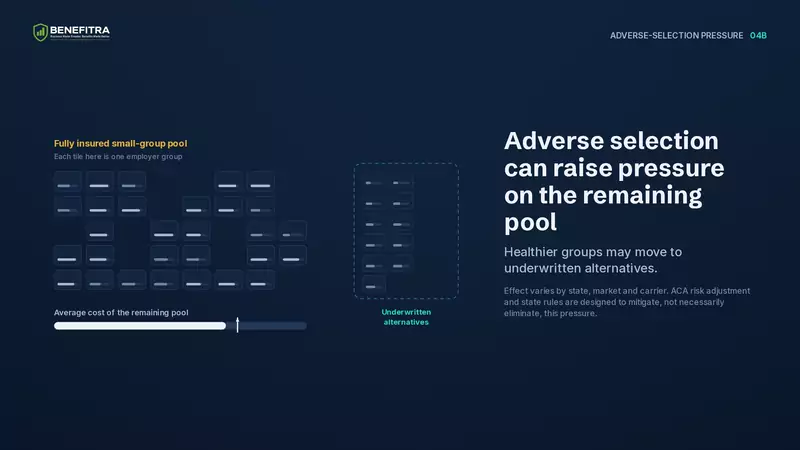
Healthier groups may qualify for underwritten level-funded, self-funded or captive alternatives, while higher-cost groups are more likely to remain in guaranteed-issue coverage. As lower-risk groups leave, the remaining pool can become more expensive. The effect varies by state, market and carrier, and ACA risk adjustment and state rules are designed to mitigate, not necessarily eliminate, this pressure.
The alternatives
-
 1:22
Level-funded: a level monthly payment is not a fixed renewal
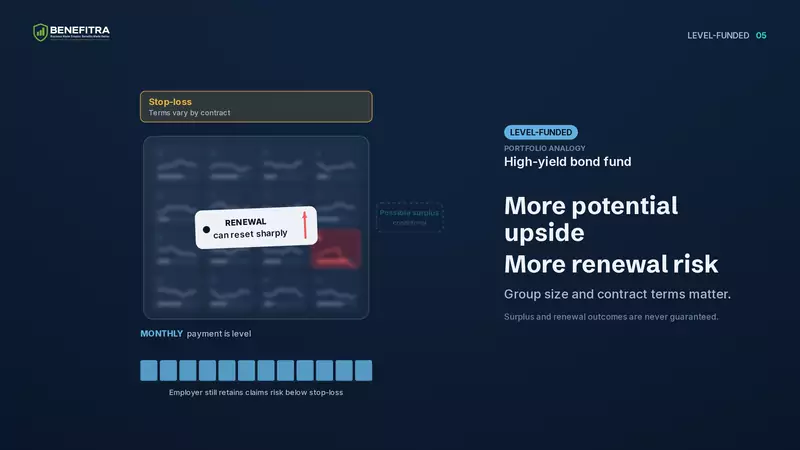
Level-funded resembles a high-yield bond fund. It may offer more upside than fully insured through conditional surplus participation, and the monthly payment is level, but the employer still retains claims risk below stop-loss. Renewal volatility can be comparable to traditional self-funding, and for a small group one claimant can sometimes create an even sharper reset. Surplus and renewal outcomes are never guaranteed.
-
 1:50
Traditional self-funding: most control, most direct volatility
Traditional self-funding is closer to an all-equity portfolio. The employer keeps favorable experience and gains the data to manage costs, but claims below stop-loss hit the employer directly, so monthly cash flow can fluctuate. Larger groups may gain stability through internal diversification. Stop-loss reimburses the plan for covered claims above the attachment point under the contract; it does not pay members directly.
-
 2:33
A group captive trades some upside for a narrower range
A group captive lets smaller employers band together to approximate large-employer scale. Each employer retains routine claims, the members share a pooled layer for mid-sized claims, and catastrophic risk transfers to stop-loss. Written protections such as limits on new lasers or renewal increases apply only when the contract actually includes them, and fees, distributions, collateral and pooling mechanics differ by captive.
Why the data matters
-
 2:17
Transparency makes active management possible
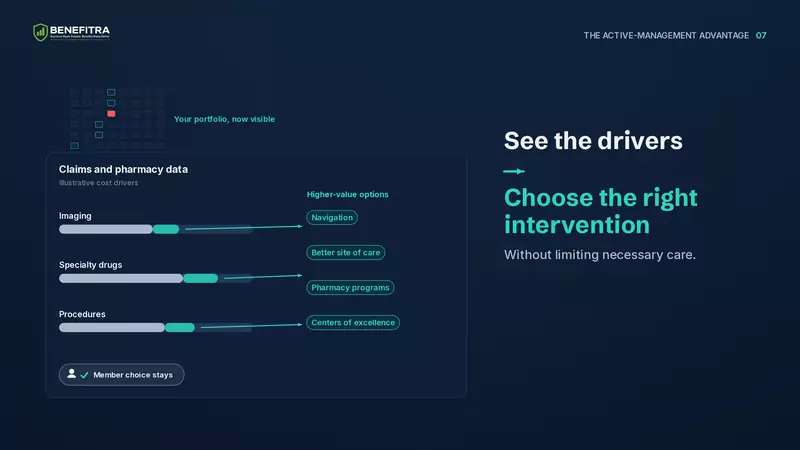
You cannot improve what you cannot see. Claims and pharmacy data can show where navigation, better sites of care, centers of excellence or pharmacy programs may improve value, without limiting necessary care.
How a group captive splits risk
A large employer with thousands of covered lives may create diversification inside its own plan. Most SMBs cannot. A group captive lets smaller employers band together to approximate that scale responsibly.
Rate caps, no-new-laser terms and similar protections are program-specific. They apply only when the named program’s written contract includes them.
Watch the captive section from 2:33- Stop-loss layer
Catastrophic claims. Stop-loss reimburses the plan for covered claims above the attachment point; it does not pay members directly.
- Pooled captive layer
Mid-sized claims, shared by the member employers.
- Employer layer
Routine claims, retained by each employer.
Who this funding video is for
- Owners
- CFOs
- Controllers
- HR leaders
Owners, CFOs, controllers and HR leaders at small and mid-sized employers who are comparing a fully insured renewal with level-funded, self-funded or captive alternatives, or who want to understand why two quotes with similar first-year prices can behave very differently over time.
It is an overview, not a plan design. Group size, claims, underwriting, reserves, plan design, pooling and the written stop-loss terms decide how any structure performs for a specific employer.
Is level-funded always riskier than traditional self-funding?
Level-funded is not automatically riskier. It is itself a form of self-funding. It smooths cash flow with a fixed monthly payment, while traditional self-funding exposes the employer to variable monthly claims below stop-loss. Renewal volatility is broadly comparable and may be lower or higher depending on group size, diversification and contract design. For a small group, one large claimant can carry heavy weight at renewal.
Does fully insured coverage protect against large renewal increases?
It transfers claims risk to the insurer, which generally lowers tail risk for a small group, but there is no universal renewal ceiling. Renewals can still rise materially because of medical trend, demographics, geography, regulation and carrier pricing.
Does a group captive pay every claim?
A group captive does not pay every claim. It has three distinct layers: each employer retains routine claims, member employers share a pooled layer for mid-sized claims, and catastrophic claims transfer to stop-loss. Stop-loss reimburses the plan for covered claims above the attachment point; it does not pay members directly.
Do all captives include rate caps or no-new-laser protection?
Not all of them do. Rate caps, no-new-laser terms and similar protections are program-specific. They apply only when the named program’s written contract includes them, so read the contract rather than relying on the category.
Will switching funding structures save money?
Not necessarily. Expected upside generally rises as an employer retains more risk, but realized results can reverse that order in any year. The aim is the best risk-adjusted outcome over time, not simply the lowest first-year quote.
Transcript
Every line of the narration, by chapter. Select a time to play the video from that point.
- 0:00The portfolio question
Choosing how to fund a health plan is a lot like choosing how to build an investment portfolio. Every structure changes what you pay, what you can see, and how much volatility you keep.
- 0:13One portfolio, many holdings
Think of each covered life as one holding. Most years are ordinary. A few produce larger costs. The question is how those results are financed and shared.
- 0:23Fully insured
Fully insured behaves like a Treasury or high-grade bond fund. You pay a known premium and transfer claims risk to the insurer. That safety and simplicity have value, but in favorable years, the insurer keeps the upside. Conceptually, it offers the lowest expected savings participation, not a guaranteed renewal outcome.
- 0:43Credibility and opacity
For small groups, pricing is often driven mainly by regulated rating factors rather than one group's own claims. As groups become more credible, their experience may matter more, but the carrier still controls the data and renewal methodology.
- 0:59Adverse-selection pressure
There is another pressure on the fully insured small-group pool. Healthier groups may qualify for underwritten level-funded, self-funded or captive alternatives, while higher-cost groups are more likely to remain in guaranteed-issue coverage. As lower-risk groups leave, the remaining pool can become more expensive, so an average or healthy employer may subsidize more of the higher-cost risk.
- 1:22Level-funded
Level-funded resembles a high-yield bond fund. It may offer more upside than fully insured through conditional surplus participation. The monthly payment is level, so the year feels predictable, but the employer still retains claims risk below stop-loss. Renewal volatility can be comparable to traditional self-funding, and for a small group, one claimant can sometimes create an even sharper reset. Surplus and renewal outcomes are never guaranteed.
- 1:50Traditional self-funded
Traditional self-funding is closer to an all-equity portfolio. It offers the greatest best-case economic upside because the employer keeps favorable experience and gains the data to actively manage costs. But claims below stop-loss hit the employer directly, so monthly cash flow can fluctuate. Larger groups may gain stability through greater internal diversification. Higher upside is potential, not a promised return.
- 2:17The active-management advantage
Transparency matters because you cannot improve what you cannot see. Claims and pharmacy data can reveal where navigation, better sites of care, centers of excellence or pharmacy programs may improve value, without limiting necessary care.
- 2:33Group captive
A large employer with thousands of covered lives may create diversification inside its own plan. Most SMBs cannot. A group captive lets smaller employers band together to approximate that scale responsibly. Like a balanced portfolio, it deliberately gives up some of traditional self-funding's best-case upside to avoid more of the worst-case downside. Each employer retains routine claims, the members share a pooled layer, and catastrophic risk transfers to stop-loss. Written protections may limit new lasers or renewal increases, but only when the contract actually includes them.
- 3:10The decision
Conceptually, expected upside rises as the employer retains more risk: fully insured, level-funded, captive, then traditional self-funded. But realized outcomes can reverse that order in any year. There is no universally best portfolio. The goal is not simply the lowest first-year quote. It is the best risk-adjusted outcome over time.
- 3:32Disclaimer
Illustrative overview. Actual risk and cost depend on plan documents, claims, underwriting and stop-loss terms.
Related guides and tools
-
 Health insurance funding hub Compare funding arrangements side by side. Open
-
 Fully insured plans A known premium, with claims risk transferred to the insurer. Open
-
 Level-funded plans A level monthly payment, with claims risk retained below stop-loss. Open
-
 Self-funded plans The most control and data, and the most direct claims volatility. Open
-
 Self-funded group captives Employer, pooled and stop-loss layers in one program. Open
-
 Level-funded calculator Estimate level-funded costs for your own group. Open
Sources
- U.S. Department of Labor, EBSA: Self-Insured Health Benefit Plans 2025, Appendix B (description of level-funded arrangements and stop-loss)
- CMS: Premium Stabilization Programs (ACA risk adjustment)
- HealthCare.gov glossary: Self-insured plan
General information, not insurance, tax or legal advice. Plan details and eligibility rules change; confirm with the plan documents, the official sources above and a licensed adviser.