

In this article 11 sections
- The 2026 creditable coverage notice starts with a plan test, not a mailing list
- CMS allows two simplified creditable coverage tests for calendar year 2026 only
- The revised 2026 method tests drug breadth, pharmacy access, and a 72 percent payment measure
- The participant notice and the CMS disclosure follow separate clocks
- Medicare eligible active workers and dependents belong in the notice population
- A 63 day gap can create a Part D penalty that follows the individual
- Benefitra's four date control puts testing, notice, filing, and retesting on one calendar
- Five records make the employer's creditable coverage determination auditable
- A prescription benefit change can force action before the next annual cycle
- The 2027 rule makes the 2026 determination a renewal design issue now
- Samuel Newland brings a financial planning lens to employer benefit decisions
Every fall someone in HR sends out the Medicare Part D creditable coverage notice, and it feels like the kind of letter nobody reads.
The letter is the easy part. The hard part happens before it, when somebody has to decide whether the company's prescription drug benefit actually pays as much as standard Medicare Part D. Get that wrong and the notice says the wrong thing to the wrong people.
For 2026 that decision is unusually awkward, because CMS is running a transition year with two valid tests. And it already signed the rule that ends the transition.
Who gets the notice is broader than most people assume. Not just retirees. Active employees who happen to be Medicare eligible, their dependents, anyone on COBRA, anyone eligible through disability, plus retirees and their dependents.
That list has been getting longer in practice. In 2025, 19.1 percent of Americans age 65 or older were working or looking for work, according to the Bureau of Labor Statistics in a report published May 28, 2026. Nearly one in five.
Four things have to happen: test the plan, notify the participants, file with CMS, and retest if the benefit changes. They usually sit in four different places. Here they sit on one calendar.
The 2026 creditable coverage notice starts with a plan test, not a mailing list
Prescription drug coverage is creditable when it is expected to pay, on average, at least as much as standard Medicare Part D. That is the whole definition.
Someone still has to reach that conclusion each year, in writing, and hand it to you. That obligation sits in CMS guidance on creditable coverage and the late enrollment penalty, which pairs an annual status determination with a disclosure notice to Medicare eligible individuals. Certain Medicare plan sponsors are carved out.
Order matters here, and it gets reversed more often than you would think. You do not decide to send the creditable notice because last year's plan felt generous. You test this year's design under a permitted method, and the result tells you which notice goes out.
On an insured plan the carrier usually hands you the determination. On a self funded plan you have to go get it from whoever holds the plan design and the actuarial data, and that means actuarial value and expected paid claims, not a gut read. Either way, four things belong in the compliance file: the written result, the method used, the benefit design that was tested, and the period it covers.
You will want that file the next time a pharmacy benefit manager rewrites the formulary or moves specialty drug terms around. Benefitra's guide to pharmacy benefit management for self funded employers covers why the prescription contract needs its own review rather than riding along with the medical plan.
CMS allows two simplified creditable coverage tests for calendar year 2026 only
Any non RDS group health plan can establish creditable status the long way, through generally accepted actuarial principles. That option never goes away.
The shortcut is where 2026 gets strange. Under the CMS 2026 Part D Redesign Program Instructions, a non RDS group health plan may use the existing simplified determination methodology or the revised simplified determination methodology. Either one. For this calendar year.
Sixty percent of participant prescription drug expenses, plus a handful of other conditions, gets you there under the older approach. The revised one wants 72 percent and rebuilds the conditions around it. Why let both run at once? Because Part D itself was changing under the Inflation Reduction Act at the same moment, and CMS did not want employer plans and Part D eligible people absorbing two shocks in one year.
Two valid answers is not the same as pick whichever one you like. Whichever method the plan uses, it has to satisfy every condition of that method. So do not accept a bare yes from a carrier or an actuary. Ask which method, in writing.
Then ask a second question, about next year. The CMS Contract Year 2027 Final Rule Fact Sheet puts the issue date at April 2, 2026, and the Contract Year 2027 Medicare Advantage and Part D Final Rule retires the old simplified method and sets the revised measure at 73 percent.
The revised 2026 method tests drug breadth, pharmacy access, and a 72 percent payment measure
Three standards, per the 2026 instructions. The plan covers brand name drugs, generics, and biological products at a reasonable level. It gives participants reasonable access to retail pharmacies. And it is designed to pay at least 72 percent of participant prescription drug expenses on average.
Here is what trips people up. Nobody took the old test and added twelve points to it. Biological products were written into the coverage requirement. Three old conditions came out entirely: the annual benefit limit, the lifetime benefit limit, and the specific annual deductible. CMS reasoned that an integrated health and drug plan can carry a bigger deductible and still deliver drug coverage that stacks up against Part D.
Why 72 and not 60? Because Part D stopped being the same product. Look at what it does in 2026 and the answer is obvious enough. A $2,100 annual out of pocket threshold. Insulin capped at $35 a month per covered product. Recommended adult vaccines with no cost sharing at all. And the coverage gap phase, which employers spent fifteen years explaining to people, is simply gone.
That reshuffle is also why a high deductible plan does not fail on sight. Maybe your maintenance drugs skip the deductible entirely. Maybe you can defend an allocation of the deductible to drug expenses. Maybe cost sharing drops hard once the deductible is met. Any of those can offset the number that worried you.

The participant notice and the CMS disclosure follow separate clocks
October 15 is the date everyone remembers. The annual notice to covered Medicare eligible individuals has to land before then.
But four other moments trigger it too, and CMS Creditable Coverage for Employers and Plan Sponsors treats them as equal obligations. Someone's initial Part D enrollment period is coming up. Someone is about to start on the employer prescription drug coverage. Creditable status flips. Or somebody simply asks.
The CMS creditable coverage disclosure is a completely different obligation. It runs online, and it is due within 60 days after the plan year starts. Two more triggers apply: 30 days after a prescription drug plan terminates, and 30 days after creditable status changes.
Read those two paragraphs again if the plan year starts January 1, because the deadlines never line up. One tracks the Part D election season in October. The other tracks the plan year in January. Move to a noncalendar plan year and the structure holds, but the filing date travels with the plan year.
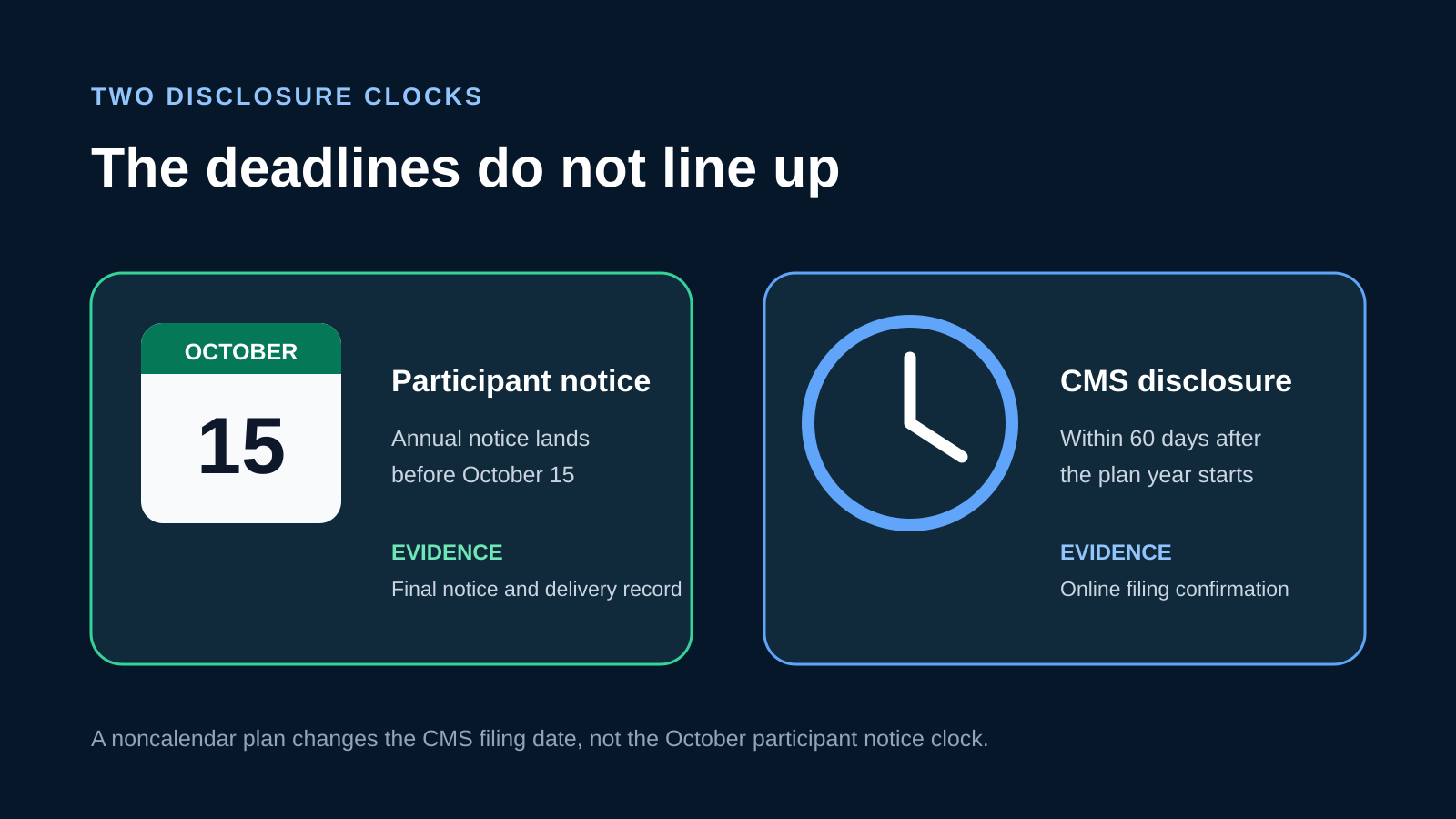
Which is why the open enrollment calendar needs two owners and two completion records, not one line item called Medicare notice. A copy of the participant notice proves nothing about the CMS filing. An online confirmation proves nothing about whether the right people got the right letter.
Medicare eligible active workers and dependents belong in the notice population
Picture the plan roster instead of the retiree list. Anyone on it who might be Medicare eligible is in scope, and CMS spells out who that covers. Active workers, and the dependents on their coverage. COBRA participants, and their dependents too. Anyone eligible through disability who sits on the prescription plan. Then the retirees, and their dependents.
A retiree only mailing list will miss most of that. The employer needs some way to identify Medicare eligibility that does not rely on age alone, while collecting no more personal information than the job actually requires. Sending the notice to everyone enrolled in the prescription plan closes the gap on dependents nobody flagged, though that approach is worth running past counsel or your administrator before you adopt it.
The workforce numbers make this less theoretical every year. Among people 65 and older in 2025, participation ran 23.1 percent for men and 15.7 percent for women.
Age already drives plan cost and enrollment behavior. Benefitra's workforce age guide shows how to factor it into a plan review without making assumptions about any individual employee.
A 63 day gap can create a Part D penalty that follows the individual
Sixty three days. That is the window.
Somebody becomes eligible, does not sign up, and has no Medicare drug coverage or other creditable prescription drug coverage. Let that run 63 days or more in a row and a Part D late enrollment penalty can attach. It is also why people dig the notice out when other coverage is ending, or when they suspect what they have is non creditable, or when they are simply trying to decide about a Medicare drug plan. Once the penalty attaches it generally stays for as long as they hold Medicare drug coverage. Limited exceptions exist.
The math is not complicated. Medicare and You 2026 puts the national base beneficiary premium at $38.99. The penalty is 1 percent of that base per full uncovered month, rounded to the nearest $0.10.
Say a woman went nineteen months uncovered before enrolling. Nineteen times 1 percent of $38.99 is $7.41, rounded to $7.40 a month. That will not ruin anyone. What surprises people is that it does not end, and it does not stay still either, because it recalculates whenever the national base premium moves.
That is the real argument for keeping the notice. It becomes the employee's proof of prior creditable drug coverage years later, which is exactly why Medicare's Notice of Creditable Coverage guidance tells recipients to hold onto it.
Benefitra's four date control puts testing, notice, filing, and retesting on one calendar
Give each event a date, an owner, and a piece of evidence. That is the entire system. It belongs in the renewal file, not in a compliance binder nobody opens.
Test date. Nothing else can start until the written creditable coverage determination exists, so put this ahead of any participant communication. What goes in the record: plan design, method, percentage standard, effective period, and the name of whoever made the call.
Notice date. October 15 anchors it, plus the other triggering events CMS identifies. Save the final notice and whatever proves it went out.
CMS filing date. Sixty days from the start of the plan year. File online, then park the confirmation somewhere other than the participant notice folder, because they are answering different questions. CMS Disclosure Guidance and Instructions walks through the process.
Retest date. No fixed date on this one. It fires when the plan terminates or the benefit changes in a way that could move creditable status, and CMS wants another online disclosure within 30 days.

None of this substitutes for legal or actuarial review. What it prevents is the failure that actually happens, where testing sits with the broker, the notice sits with HR, the filing sits with nobody, and no one person can confirm all three are done.
Five records make the employer's creditable coverage determination auditable
Imagine someone opening this file in 2028. Maybe an auditor, maybe just the person who replaced you. They should be able to piece the whole thing together without calling anybody.
Start with the benefit design that actually got tested, formulary and cost sharing included, because the determination is meaningless detached from what it measured. Next to it, the written creditable or noncreditable determination itself, showing which method produced it and what period it covers. Then the final participant notice, exactly as it went out, including any contact information your company added to the CMS model. Then whatever demonstrates the notice reached the covered population, and when. Last, the online CMS disclosure confirmation, along with any additional filing a termination or status change forced later.
CMS publishes model creditable and noncreditable notice letters that entities can modify for their own use, and plans may keep using existing model language as long as every required data element is still there.
Worth saying plainly: the model is a letter, not a determination. Filling one out does not test anything.
A prescription benefit change can force action before the next annual cycle
Do not wait for October if something moves midyear.
Creditable status changing is itself a trigger. Thirty days to file another online CMS disclosure, and the participant notice rules activate alongside it. If the coverage has gone non creditable, both obligations land together.
Changes worth routing back through the determination process: a new pharmacy benefit manager, a formulary revision, a different deductible treatment for prescriptions, new coinsurance, a specialty drug carve out, a rebuilt retail pharmacy network. Whether any specific change actually moves the status is a question for whoever performs the determination. It is not something HR should be guessing at in a meeting.
Renewal governance is the fix. Benefitra's article on specialty benefit carve outs covers why a separate vendor arrangement still has to be evaluated as part of the whole plan.
While you are in there, check that the Summary of Benefits and Coverage, the enrollment guide, the plan document, and the actual prescription contract all describe the same benefit. They drift. Benefitra's guide to reading an SBC helps spot where a summary stops answering a contract level question.
The 2027 rule makes the 2026 determination a renewal design issue now
Seventy three percent, starting in 2027. CMS also turned down the idea of extending the old method one more year, which closes the door on the workaround most employers were quietly counting on.
So a plan that clears the 60 percent method this year has learned nothing about next year. Ask for the 2027 test during the 2026 renewal, while pharmacy terms and employee contributions are still on the table.
Three outcomes are possible. Nothing needs to change. The prescription benefit needs a design adjustment. Or the plan goes noncreditable, in which case the affected people need an accurate notice so they can make a real decision about Part D.
Benefitra's job is to put that determination next to the funding, pharmacy, and communication decisions that shape the renewal, rather than treating it as a compliance chore that arrives in September. The Benefits Savings Strategy Builder helps organize those questions without attaching a made up savings percentage to compliance work.
Samuel Newland brings a financial planning lens to employer benefit decisions
Samuel Newland, CFP came to employee benefits from financial planning, and it shows in how he approaches plan design and funding. Fully insured, level funded, self funded, captive, ICHRA, PEO integrated, Taft Hartley. He founded Benefitra and works across all of them.
This article is educational and is not legal, tax, actuarial, or Medicare enrollment advice. Confirm your plan's creditable coverage status with the carrier, administrator, actuary, or benefits counsel responsible for making the determination.
Frequently asked questions about the 2026 creditable coverage notice
When is the Medicare Part D creditable coverage notice due in 2026?
Before October 15 for the annual notice. Four other triggers apply as well: someone's initial eligibility for Medicare Part D, their enrollment in the employer prescription plan taking effect, a change in creditable status, and any request.
Who must receive a creditable coverage notice from an employer?
Anyone on the plan who may be Medicare eligible. Active workers and dependents, COBRA participants and dependents, people covered through disability, retirees, and retiree dependents.
What percentage makes prescription coverage creditable in 2026?
There is no single number, because a plan can establish creditability through actuarial value instead. Under that approach, coverage is creditable when expected paid claims for prescription drugs meet or exceed the Medicare Part D standard. For calendar year 2026 only, the existing simplified method sets a 60 percent payment measure and the revised simplified method sets 72 percent, each with its own additional conditions.
Does an employer send the creditable coverage notice to CMS?
No, and this confuses people every year. The participant notice and the CMS filing are two separate things. Medicare tells individuals to keep their notice rather than send it in. The employer or plan sponsor files separately through the online Disclosure to CMS Form.
What is the CMS disclosure deadline for a calendar year plan?
Sixty days from the start of the plan year. Termination of coverage or a change in creditable status starts a separate 30 day clock.
Can an employer use the 60 percent simplified test in 2027?
No. The 2027 final rule ended the old simplified method after the 2026 transition year. For 2027 the revised simplified method uses a 73 percent payment measure, or the plan can establish actuarial equivalence under the applicable rule.