

When an employee leaves, the next question is often how much COBRA insurance costs. For employers, the answer is not a single number. It is a formula tied to the plan's full premium, a federal ceiling, and the specific qualifying event. Get the explanation right and the exiting employee can budget. Get it wrong and the first invoice triggers panic, non-enrollment, or a compliance complaint.
This guide is for small and mid-size employers and HR teams who need to price COBRA continuation coverage, explain the cost, and stay inside the federal rules.
What Employers Pay for COBRA Insurance
COBRA does not require the employer to subsidize continuation coverage. The qualified beneficiary generally pays the full cost of the plan, including the portion paid through payroll deduction and the amount the employer previously covered on the employee's behalf. A group health plan may also add up to 2% for administrative costs, according to the DOL Employer’s Guide to Group Health Continuation Coverage Under COBRA.
Most people therefore see a sharp increase. If the employee was paying $150 a month out of paycheck for family coverage while the employer paid $1,800, the COBRA invoice reflects the full plan cost plus the administrative fee. The employer's role is to calculate the amount correctly and send the election notice on time, then collect the premium through the plan's normal process.
Some employers choose to cover part or all of the COBRA cost as part of a severance arrangement. That is allowed, but it is a voluntary employer subsidy, not a federal requirement. Any subsidy should be documented clearly so the plan administrator can report the correct premium.
How the 102% Premium Rule Works
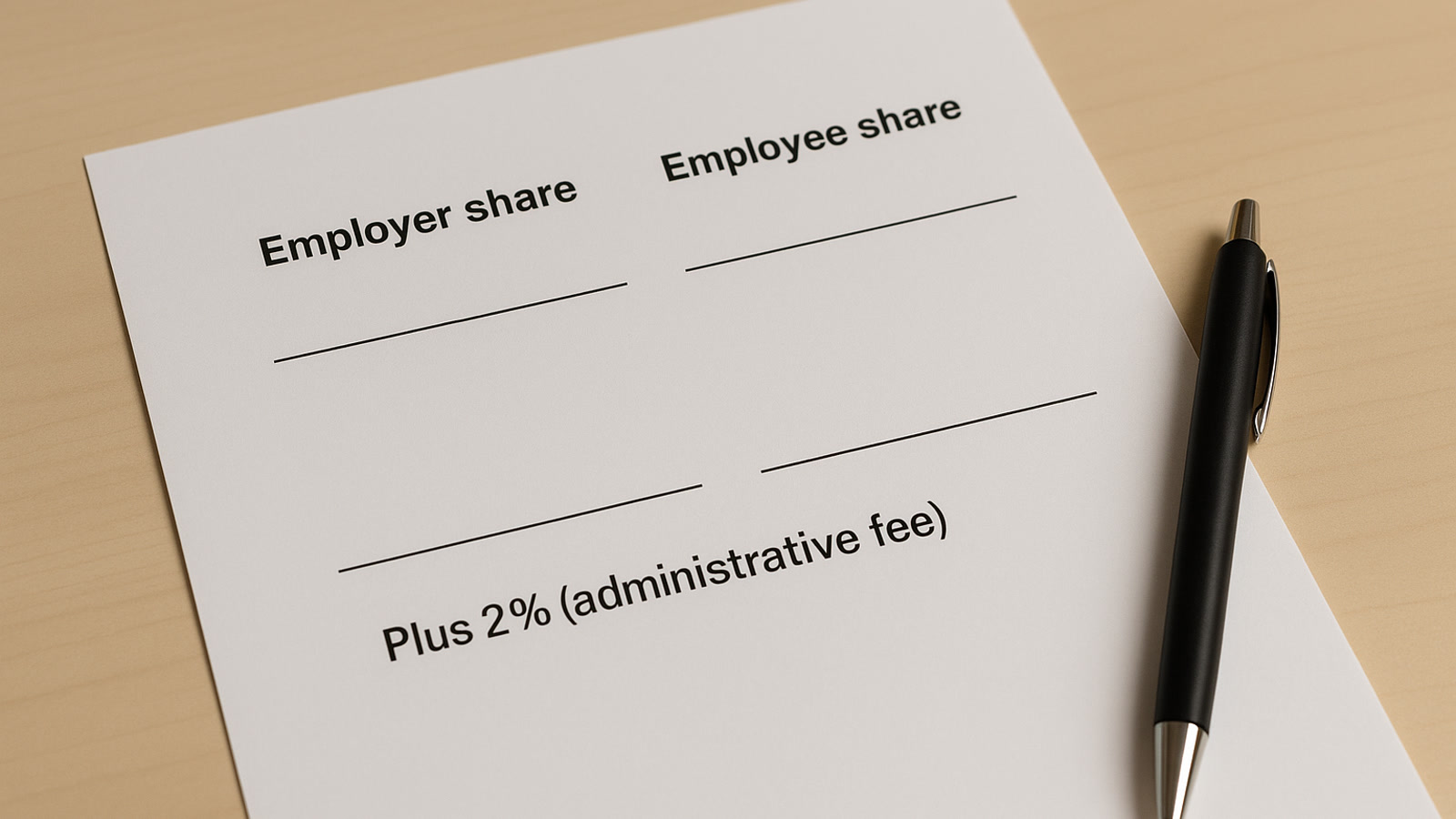
Federal law sets the ceiling at 102% of the total cost of coverage. The monthly COBRA premium is the full health plan premium plus the allowed 2% administrative charge.
Once the plan's total cost is known, the math is simple. For a plan with a $1,000 total monthly premium, the cost of COBRA would be $1,020 per month. For a plan with a $2,000 family premium, the maximum premium is $2,040. Plans may charge less, but they cannot charge more than 102% for the standard continuation period.
During the 11-month disability extension, the ceiling rises to 150% of the total cost. This extension applies when a qualified beneficiary is disabled at the time of the qualifying event or becomes disabled during the first 60 days of continuation coverage, and the Social Security Administration makes the disability determination. The CMS COBRA Continuation Coverage Fact Sheet confirms the 150% rate for the disability extension period.
If the plan's overall premium increases during the continuation period, the COBRA premium can increase with it, provided the plan applies the same increase to active employees. The 102% ceiling applies to the new total cost.
Average COBRA Insurance Cost in 2026
A 2026 national premium survey has not been released yet. The most recent complete data is the KFF 2025 Employer Health Benefits Survey, which reported an average annual premium of $9,325 for single coverage and $26,993 for family coverage.
Those averages translate into useful COBRA invoice benchmarks. Single coverage averages about $777 a month before the administrative fee and $793 after the 2% charge. Family coverage averages about $2,249 a month before the fee and $2,294 after it.
These figures are averages, not predictions. The actual COBRA cost for any employer depends on the plan's negotiated premium and the employee's coverage tier, with local market adjustments on top. A small employer with a fully insured plan in a high-cost state may see premiums well above the national average. A large employer with a self-insured plan may see lower administrative fees but still must pass through the full plan cost.
KFF also reported that in 2025 covered workers contributed an average of $1,440 a year for single coverage and $6,850 a year for family coverage. The rest was employer-paid. That gap explains why a former employee's first COBRA invoice can feel like a shock. The amount is not arbitrary; it is the full plan cost that was already being paid, just split differently while the person was employed.
How Long COBRA Coverage Lasts
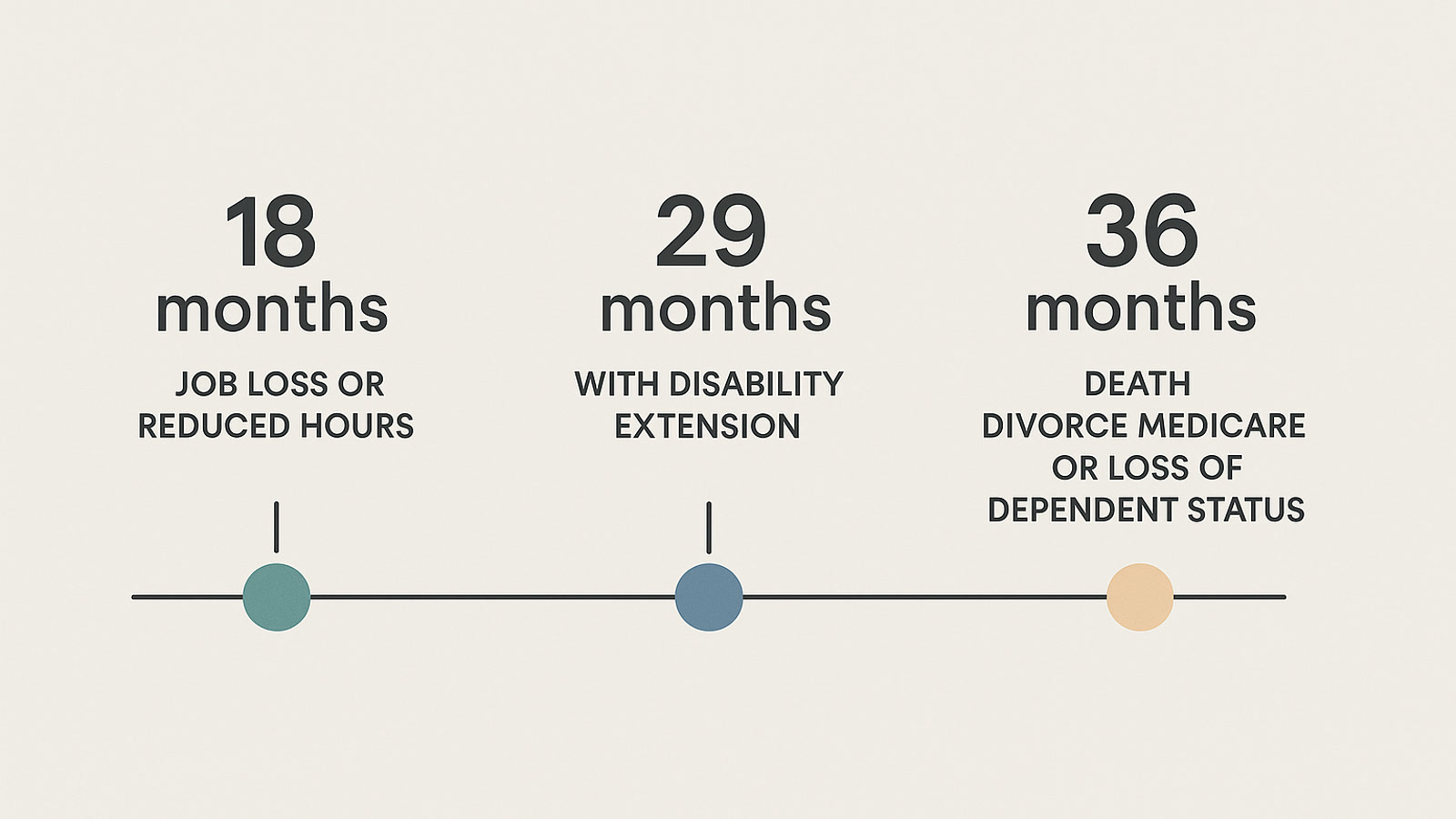
COBRA coverage typically lasts 18 to 36 months, depending on the qualifying event. The DOL Employer’s Guide sets out the standard durations.
Termination of employment for reasons other than gross misconduct, or a reduction in work hours, triggers up to 18 months of continuation coverage for the employee, spouse, and dependent children. If a second qualifying event occurs during that 18-month window, such as the employee's death or a divorce, the spouse and dependents may extend coverage up to a total of 36 months from the original event.
Death of the covered employee, divorce or legal separation, the employee's entitlement to Medicare, or a dependent child losing dependent status under the plan each triggers up to 36 months of coverage for the affected spouse and dependents.
A disability extension stretches the 18-month period to 29 months for the disabled qualified beneficiary and family members who were covered under the 18-month continuation. The plan may charge up to 150% of the total cost during the additional 11 months.
Coverage is retroactive to the date of the qualifying event once the beneficiary elects COBRA and pays the initial premium. The election period is at least 60 days, measured from the later of the date the COBRA election notice is provided or the date coverage would otherwise be lost, as the CMS COBRA Q&A explains.
Who Qualifies for COBRA Continuation
Continuation coverage applies to qualified beneficiaries who lose group health coverage because of a qualifying event. For the covered employee, the qualifying events are termination of employment for any reason other than gross misconduct, or a reduction in hours that causes loss of coverage.
For the spouse and dependent children, the list is longer. It includes the employee's qualifying events plus the employee's death, divorce or legal separation, the employee's entitlement to Medicare, or the dependent child losing dependent status under the plan's terms.
The federal law covers private-sector employers and state or local government employers with 20 or more employees on more than 50% of typical business days during the prior calendar year. Employers below that threshold are not covered by federal COBRA, but they may be covered by a state continuation law.
A qualified beneficiary must have been covered under the group health plan the day before the qualifying event. A dependent who was not actually enrolled generally cannot elect COBRA separately. The employer's COBRA administration process, including the initial election notice and the 60-day election window, is covered in more detail in our COBRA administration compliance guide.
State Mini-COBRA and Smaller Employers
Businesses with fewer than 20 employees are outside federal COBRA, but many states have their own continuation coverage laws, often called mini-COBRA. These laws vary by state. They may set a different employer size threshold, define eligible events differently, set a different length of continuation, change election deadlines, or cap the administrative charge.
Some states extend continuation to employers with as few as two employees. Others mirror federal rules but add notice or timing requirements. A few states require coverage periods longer than federal COBRA or limit the administrative charge differently.
Start by contacting the state Department of Insurance or the plan administrator. The DOL Employer’s Guide notes that state insurance departments are the right place to confirm whether a state continuation law applies. Employers should not assume that federal rules fill the gap, and they should not assume every state law is identical.
Small employers that use a PEO may have continuation coverage handled through the PEO's plan. The specifics depend on the PEO agreement and whether the plan is fully insured or self-insured. Our COBRA administration and PEO guide explains how PEOs can take the notice and tracking workload off a small HR team.
How to Explain COBRA Cost to Employees
Use the election notice as the main tool for preventing sticker shock. It must explain the premium, the due dates, the consequences of non-payment, and the election procedures. When the numbers are clear, employees can compare COBRA to other coverage options, such as a spouse's plan or a Marketplace plan.
A useful explanation breaks the premium into the former employer contribution and the former employee contribution, then adds the 2% administrative fee. Showing the math makes the increase understandable. It also protects the employer from the common misunderstanding that the company raised the price. It is also worth noting that COBRA preserves the exact same plan benefits and same network the employee had while active, which is why some people keep it despite the cost.
Also explain timing. The first premium covers the period from the qualifying event date through the current month and must be paid within 45 days after electing COBRA. After that, monthly premiums are due on the date the plan sets, with a grace period of at least 30 days. Missing the grace period can terminate coverage retroactively.
Employees with a Health Savings Account can use IRS Publication 969 to confirm that COBRA premiums count as a qualified medical expense. That means the premium can be paid or reimbursed tax-free from HSA funds, which can soften the cash-flow impact. Employers should mention this option only as general information, not as tax advice.
Where the goal is to keep departing employees covered without the full COBRA burden, an employer can explore whether a PEO or benefits platform offers a more manageable continuation structure. For employers considering a broader benefits change, our employee benefits overview describes how integrated benefits administration can reduce the manual work behind notices, eligibility tracking, and premium collection.
Frequently Asked Questions
How is COBRA insurance cost calculated?
COBRA cost is calculated as up to 102% of the total cost of coverage for similarly situated active employees. The total cost includes both the employer and employee shares of the premium, plus up to 2% for administration.
What makes a COBRA premium higher than a paycheck deduction?
The paycheck deduction was only the employee share. COBRA generally requires payment of the full premium, which includes the employer share that was previously subsidized.
When does the COBRA election period end?
Qualified beneficiaries have at least 60 days to elect COBRA. The period ends on the later of 60 days after the election notice is provided or 60 days after coverage would otherwise be lost.
Is an employer allowed to subsidize COBRA premiums?
Yes, an employer may subsidize part or all of the COBRA premium, but it is not required to do so. Any subsidy should be documented so the plan administrator can report the correct amount.
Which employers must offer federal COBRA?
Federal COBRA applies to employers with 20 or more employees. Smaller employers may be covered by a state mini-COBRA law, which varies by state.
Are COBRA premiums an HSA qualified expense?
Yes. COBRA premiums are a qualified medical expense under IRS rules, so they can be paid or reimbursed tax-free from a Health Savings Account.