

Six months ago, you had zero employees. Today you have 15. Next quarter you're projecting 25. You're running payroll on spreadsheets, your "benefits package" is a vague promise, and your top producer just asked about health insurance for the third time this week.
This is what we call The Benefits Gap Trap: the window between when a company needs real benefits infrastructure and when it thinks it can afford it. At Business Insurance Health and BENEFITRA, we see this pattern constantly in companies scaling from 5 to 50 employees. The companies that close this gap early retain their best people. The ones that wait lose them to competitors who offer what you don't.
The data backs this up: 56% of employees say benefits are a major factor in whether they stay at a job, and the cost of replacing an employee ranges from 50–200% of their annual salary when you factor in recruiting, onboarding, and lost productivity. For a company growing fast, every departure is a setback multiplier.
- The "Benefits Gap Trap": fast-growing companies lose key hires to competitors with better benefits packages during the 10–50 employee scaling phase.
- PEOs give companies with as few as 5–10 employees access to Fortune 500-level health plans, 401(k), dental, vision, and life insurance from day one.
- NAPEO data: PEO clients grow 7–9% faster and have 10–14% lower employee turnover than comparable businesses.
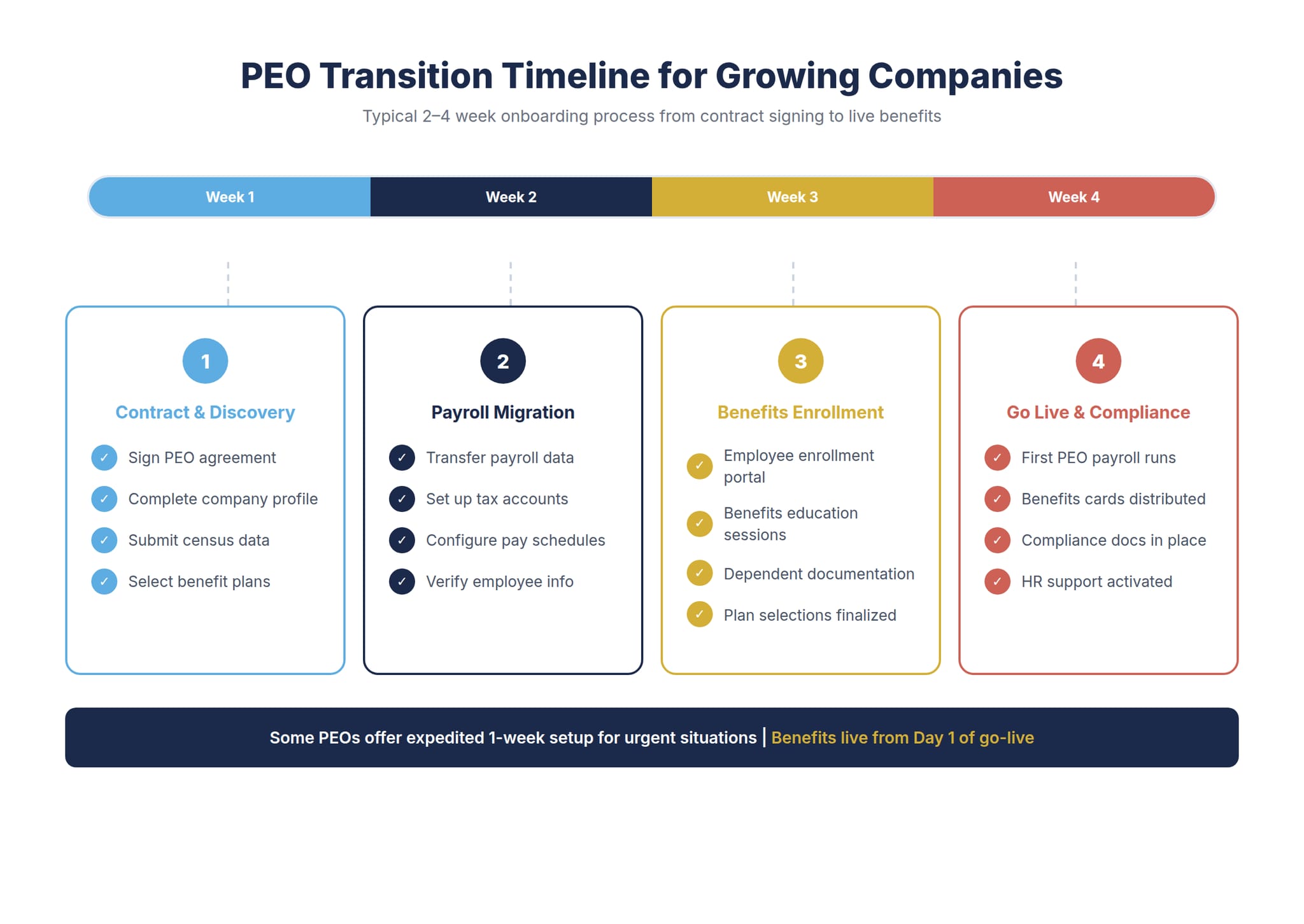
- The transition from basic payroll to PEO typically takes 2–4 weeks and includes benefits enrollment, payroll migration, and compliance setup.
- Cost: PEO admin fees add $40–$160 PEPM, but enterprise health insurance access often saves 15–35% vs. small group rates.
The Benefits Gap Trap: Why Growing Companies Lose Top Talent
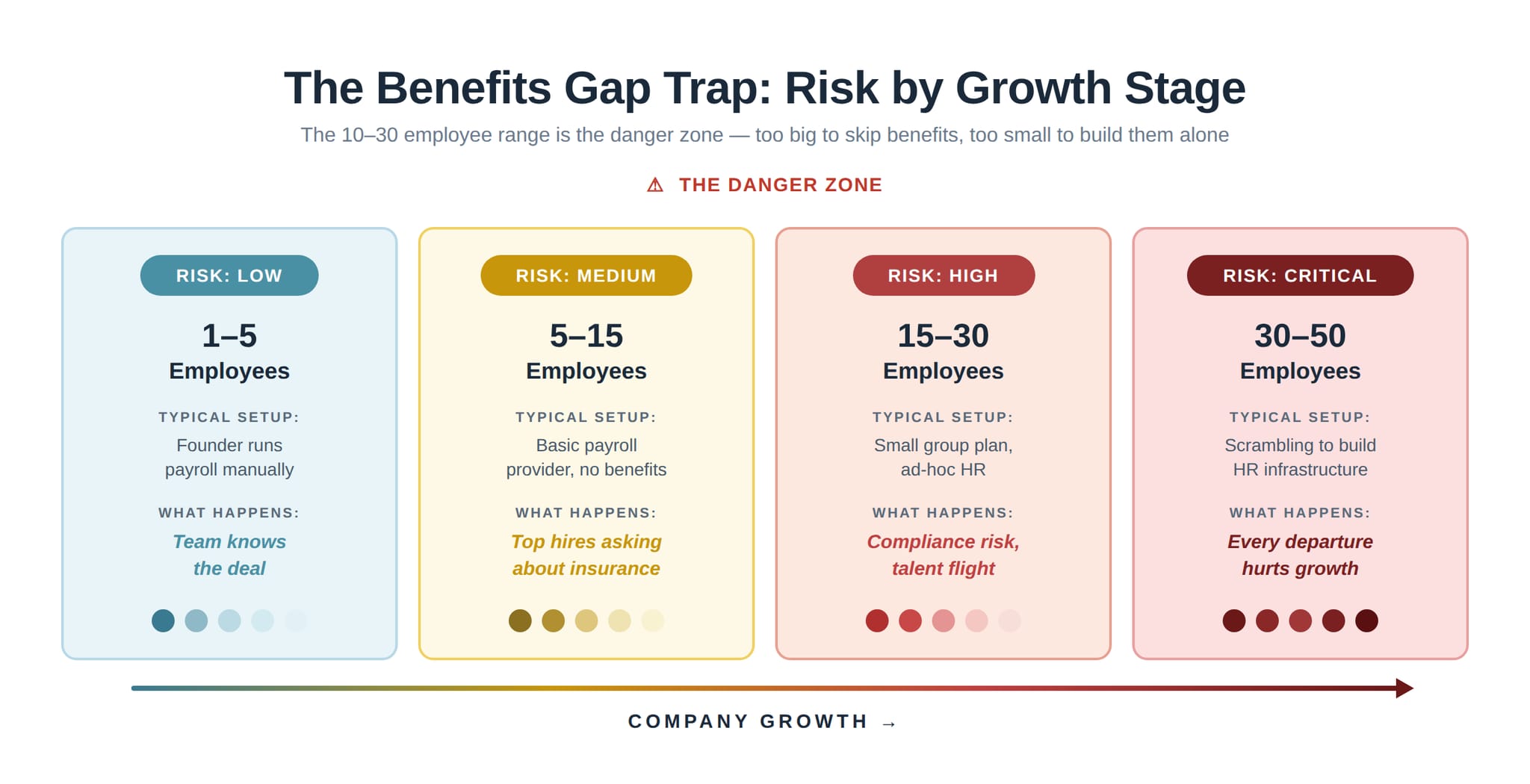
Here's the typical growth-stage timeline we see at BENEFITRA:
| Stage | Typical Setup | Risk |
|---|---|---|
| 1–5 employees | Founder runs payroll manually or via basic tool | Low — team knows the deal |
| 5–15 employees | Basic payroll provider, no benefits | Medium — top hires asking about insurance |
| 15–30 employees | Maybe a small group plan, ad-hoc HR | High — compliance risk, talent flight |
| 30–50 employees | Scrambling to build HR infrastructure | Critical — every departure hurts growth |
The Benefits Gap Trap hits hardest in the 10–30 employee range. You're too big to run without benefits but feel too small to afford them. The math says otherwise.
How a PEO Closes the Benefits Gap for Fast-Growing Companies
A PEO solves the growth-stage benefits problem by giving small companies immediate access to benefits infrastructure that would otherwise require 100+ employees to assemble independently:
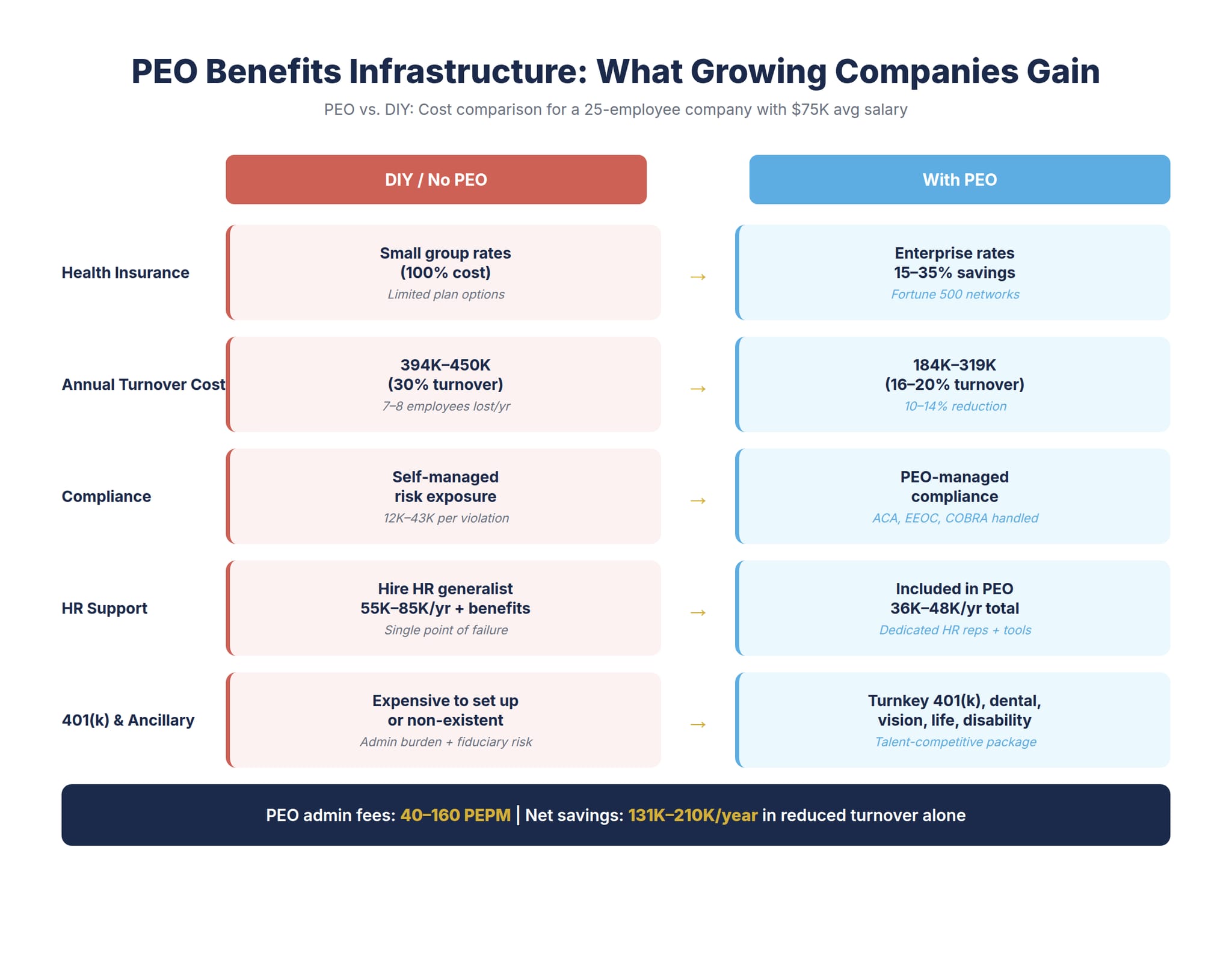
Enterprise health insurance from day one. PEOs pool thousands of employees across client companies into a master health plan, giving your 15-person team access to the same UnitedHealthcare, Aetna, or BCBS PPO networks that a 5,000-person company uses. At BENEFITRA, we've seen PEO health rates come in 15–35% below small group fully insured rates for growing companies.
Turnkey payroll and compliance. State tax registrations, new-hire reporting, ACA compliance, EEOC requirements, COBRA administration — these aren't optional once you cross 5–50 employees, and mistakes are expensive. SHRM estimates that compliance failures cost small businesses $12,000–$43,000 per violation on average.
401(k) and ancillary benefits. Dental, vision, life insurance, disability, and retirement plans are standard PEO offerings. For a growing company competing for talent against established firms, this package-level parity can be the difference between landing a key hire and losing them.
Scalable HR support. When you grow from 15 to 40 employees in a year, your HR needs change weekly. PEOs provide dedicated HR representatives, employee handbooks, onboarding workflows, and termination guidance without requiring you to hire a full-time HR person.
The Hidden Math: Cost of Not Having Benefits vs. PEO Investment
The Turnover Cost Multiplier
Let's model the cost of losing employees because you don't offer competitive benefits:
| Parameter | Value |
|---|---|
| Employees | 20 (growing to 35) |
| Avg salary | $65,000–$85,000 |
| Turnover without benefits | 25–35% annually (BLS JOLTS avg for small firms) |
| Turnover with PEO benefits | 15–25% (10–14% reduction per NAPEO) |
| Replacement cost per employee | 50–200% of salary (SHRM) |
At 25 employees with $75,000 average salary and 30% turnover, you're losing ~7–8 employees per year. Replacement cost at 75% of salary: $393,750–$450,000 annually in turnover costs. Reducing turnover by 10–14 percentage points saves $131,000–$210,000/year — far exceeding the PEO admin fee of $36,000–$48,000.
BIH model estimate combining SHRM replacement cost data with NAPEO turnover reduction benchmarks. Actual turnover varies by industry, geography, and company culture.
Benefits ROI Calculator at Business Insurance Health
No login required. No email gate. Free.
When to Make the PEO Transition: Timing the Switch
Based on our experience at BIH and BENEFITRA, the optimal PEO entry points are:
Before your first key hire asks about benefits. If a critical employee is asking about health insurance, you're already behind. The PEO enrollment process takes 2–4 weeks from contract signing to live benefits.
Before you cross compliance thresholds. At 50 employees, ACA employer mandate kicks in. At 15, EEOC requirements begin. At 20, COBRA obligations start in many states. PEOs handle these transitions automatically.
During a funding or revenue milestone. Just closed a round or landed a major contract? That's the moment to invest in benefits infrastructure. The cost is marginal relative to the capital deployed, and the talent retention impact is immediate.
For a detailed cost comparison between PEO models and standalone alternatives, see our PEO cost analysis breakdown. And for employers already considering PEO alternatives, our guide to ADP TotalSource alternatives compares the major providers.
Frequently Asked Questions About PEOs for Growing Companies
How many employees do I need to join a PEO?
Most PEOs accept companies with as few as 5–10 employees, though pricing and plan options improve as you scale. The sweet spot for PEO value is typically 15–100 employees, where you're large enough to benefit from pooled rates but too small to justify building benefits infrastructure in-house.
Can I keep my PEO benefits if my company grows past 100 employees?
Yes, but you should re-evaluate the math at 75–100+ employees. At this scale, your company may qualify for direct carrier negotiation, level-funded plans, or Taft-Hartley trusts that offer comparable or better rates without the PEO admin premium.
How quickly can a PEO set up benefits for my team?
Typical onboarding takes 2–4 weeks from contract signing. This includes payroll migration, benefits enrollment, compliance documentation, and employee communications. Some PEOs offer expedited 1-week setups for urgent situations.
Will my employees know we use a PEO?
Yes — the PEO will appear as the employer of record on W-2s and some benefits cards. Most employees don't mind; they care about the quality of coverage and the benefits available to them, not the administrative structure behind it.
Is a PEO better than hiring an HR person for a growing company?
A full-time HR generalist costs $55,000–$85,000/year plus benefits. A PEO for 25 employees costs $36,000–$48,000/year in admin fees and includes HR support, compliance, benefits administration, and payroll. For companies under 50 employees, the PEO typically provides more complete HR coverage at a lower total cost. Above 50, the calculus shifts toward in-house HR combined with standalone benefits.
Business Valuation Tool at Business Insurance Health
No login required. No email gate. Free.
References
- SHRM. "Employee Benefits Survey: Impact on Retention." 2024. shrm.org
- SHRM. "The Real Costs of Recruitment." 2024. shrm.org/topics-tools/news/talent-acquisition
- SHRM. "Compliance Costs for Small Businesses." 2024. shrm.org
- Bureau of Labor Statistics. "JOLTS: Job Openings and Labor Turnover Survey." Q4 2025. bls.gov/jlt/
- NAPEO/McBassi & Company. "PEO Industry White Paper: Growth and Turnover Impact." 2024. napeo.org
- Kaiser Family Foundation. "2024 Employer Health Benefits Survey." October 2024. kff.org
- U.S. Chamber of Commerce. "Small Business Benefits and Workforce Report." 2025. uschamber.com
This analysis is provided for educational purposes and does not constitute financial or legal advice. Consult your compliance counsel and benefits advisor for guidance specific to your situation.