

In this article 6 sections
Key Takeaways
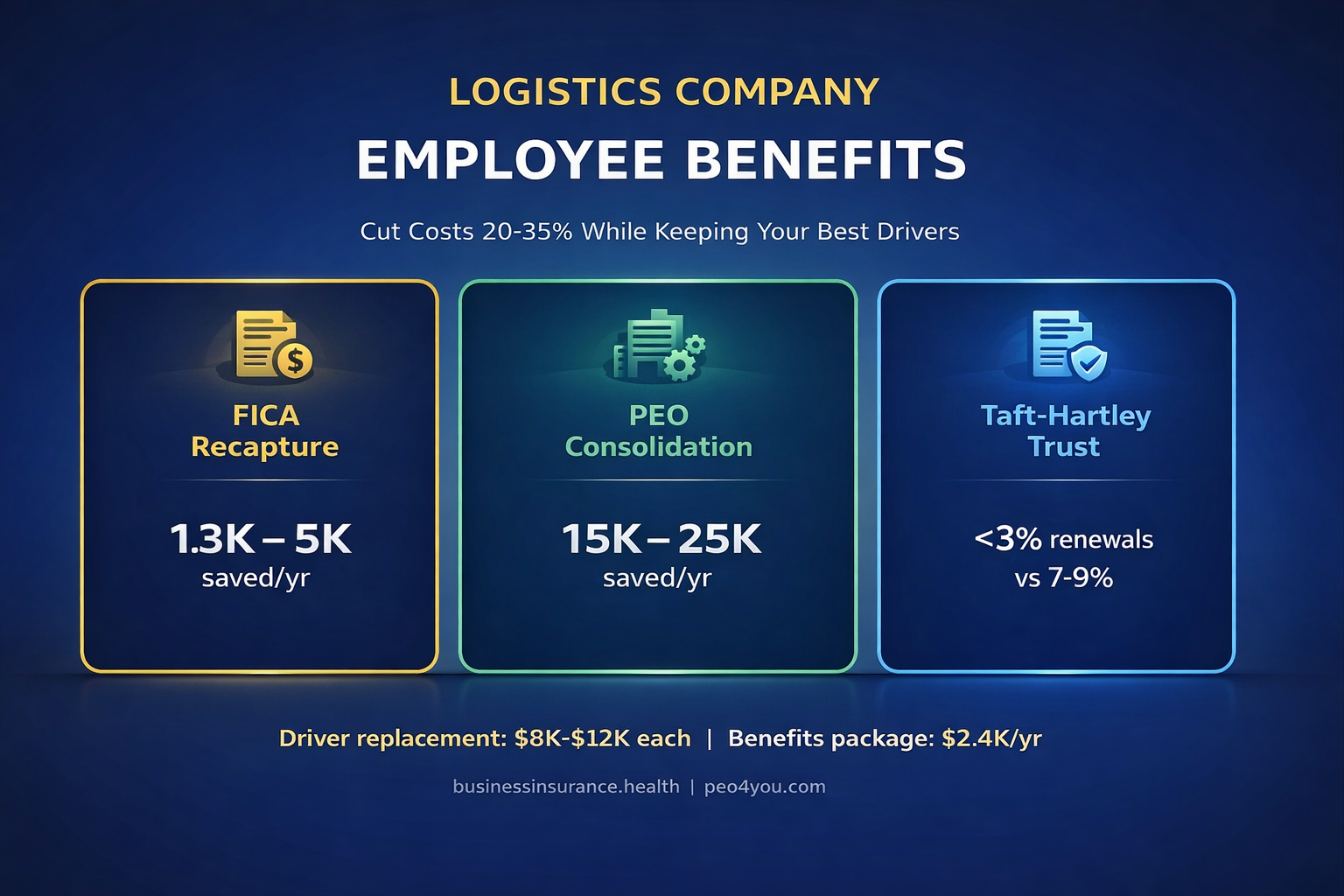
- Large truckload carriers report annual driver turnover above 90%1 — each replacement costs $8,000 to $12,000 in recruiting, training, and lost productivity.
- The FICA Recapture Method uses a Section 125 cafeteria plan with a fixed indemnity overlay to save employers $60 to $100 per employee per month in payroll taxes — without changing take-home pay.
- A PEO consolidation can replace 3 to 5 separate vendor relationships (payroll, benefits, workers' comp, 401(k), compliance) while reducing total cost 15% to 25%.2
- Taft-Hartley multiemployer plans offer logistics companies renewal stability under 3%, compared to 7% to 9% for small group fully insured plans.3
- Combined FICA recapture + PEO consolidation can save a 7-employee logistics company $15,000 to $30,000 per year — enough to fund a full benefits package that drives retention.
The Real Cost of Driver Turnover in Logistics
The American Trucking Associations reported that the trucking industry employed 3.58 million professional drivers in 2024, with large truckload carriers experiencing turnover rates above 90%.1 For smaller fleet operators and FedEx contractors with 5 to 20 drivers, turnover is typically lower but the per-driver replacement cost is proportionally higher because there is no HR department to absorb the work. When we model turnover costs for small logistics companies at BIH and BENEFITRA, the numbers look like this:| Turnover Cost Component | Per Driver |
|---|---|
| Indeed/recruiting advertising | $300–$500 |
| Background check + drug screening | $150–$300 |
| Onboarding and training (2–3 weeks) | $2,000–$4,000 |
| Productivity loss during ramp-up (4–8 weeks) | $3,000–$5,000 |
| Administrative time (owner/manager) | $500–$1,000 |
| Route coverage gaps (missed deliveries) | $1,000–$2,500 |
| Total cost per driver turnover | $7,000–$13,300 |
The FICA Recapture Method: How Logistics Companies Fund Benefits Without Raising Costs
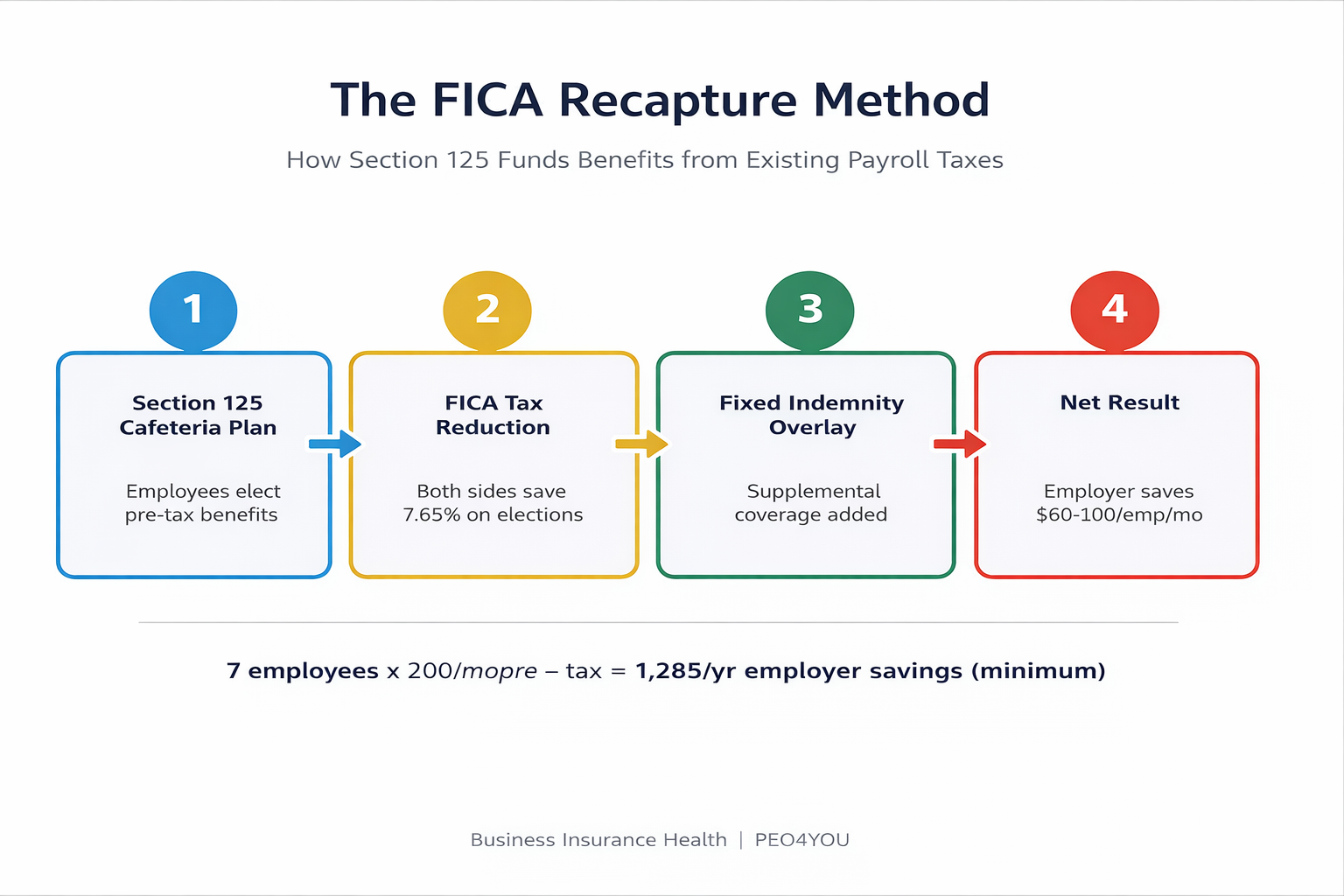
Hidden Math: The FICA Recapture Method for a 7-Employee Logistics Company
Model employer: Logistics contractor, 5 W-2 drivers + 2 admin, average salary $48,000| Step 1: Fixed indemnity plan election per employee | $200/month pre-tax |
| Step 2: Employer FICA savings (7.65% × $200 × 7 employees × 12 months) | $1,285/yr |
| Step 3: Employee FICA savings (same calculation, per employee) | $184/yr per employee |
| Step 4: Additional fixed indemnity benefit value per employee | $2,400/yr in supplemental coverage |
| Total employer savings | $1,285/yr minimum |
| Per-employee benefit gained | $184 tax savings + $2,400 supplemental coverage |
At higher election levels ($400–$600/month where salary supports it), the employer savings scale to $2,500–$5,000/yr. BIH model estimate. Exact savings depend on election amounts and employee wage levels. Employees earning above the Social Security wage base ($176,100 in 2025) save on the Medicare portion only (1.45%).
Why Logistics Companies Are Switching to PEO Models
A typical small logistics company manages benefits across multiple disconnected platforms: QuickBooks for payroll, a separate 401(k) provider, an individual workers' comp policy, and either no health benefits or an expensive small group plan with no carrier leverage. Each vendor has its own admin portal, its own renewal cycle, and its own fee structure. The total cost of this fragmented setup is consistently 15% to 25% higher than a consolidated PEO health coverage model.2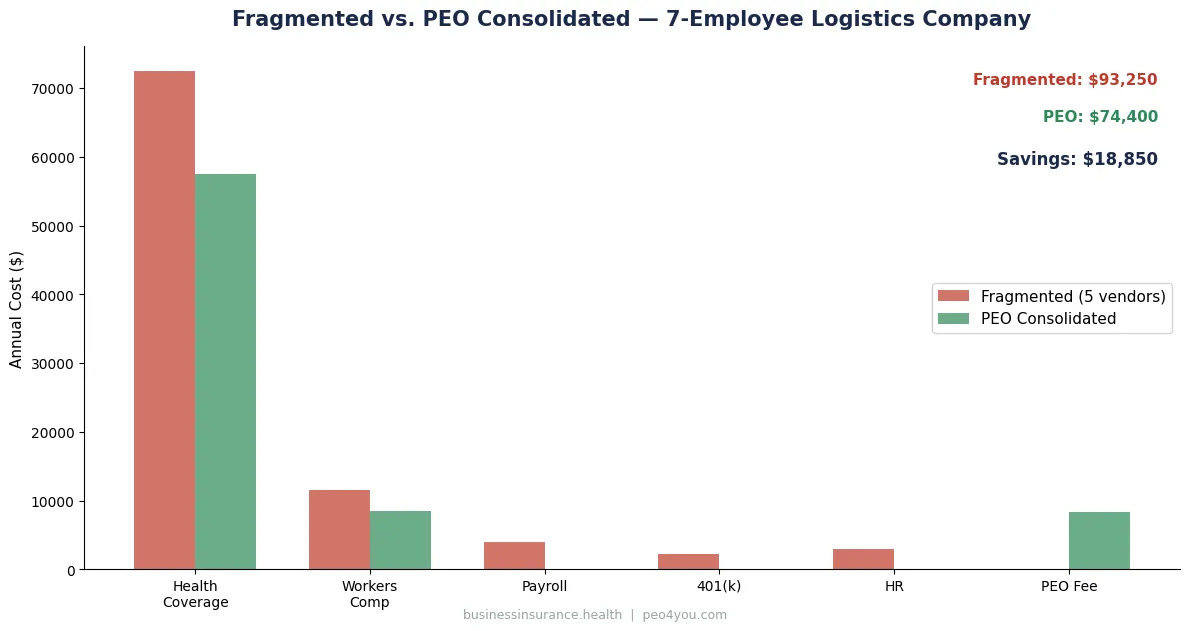
| Cost Category | Fragmented (Current) | PEO Consolidated |
|---|---|---|
| Health coverage (7 employees) | $65,000–$80,000 | $50,000–$65,000 |
| Payroll processing | $3,000–$5,000 | Included |
| Workers' comp | $8,000–$15,000 | $6,000–$11,000 |
| 401(k) admin | $1,500–$3,000 | Included |
| HR compliance / handbook | $2,000–$4,000 | Included |
| PEO admin fee | N/A | $6,300–$10,500 |
| Annual total | $79,500–$107,000 | $62,300–$86,500 |
| Annual savings with PEO | $15,000–$25,000 (15%–25%) | |
How Benefits Drive Driver Retention in Logistics
SHRM's 2025 Employee Benefits Survey found that 88% of employers rate health coverage as a "very important" or "extremely important" factor in job satisfaction.5 In logistics, where the labor pool is tight and the work is physically demanding, benefits are a direct retention tool. Here is what we have seen work for logistics companies that implement full benefits through a PEO or Taft-Hartley multiemployer arrangement:- Turnover reduction of 20% to 40% within the first 12 months2
- Recruiting cost savings of $2,400 to $8,000 per year (fewer Indeed postings, faster fills)
- Workers' comp savings of 10% to 20% through PEO loss control programs and pay-as-you-go billing
Taft-Hartley Plans: The Logistics Industry's Best Kept Secret
Most logistics benefits conversations stop at "fully insured or self-funded." But for companies with 5 to 50 employees, Taft-Hartley multiemployer plans offer a third path that delivers large-group stability without large-group size. The mechanics: a collectively bargained trust pools your employees with workers from other participating employers. The larger pool means:- Premium renewals consistently under 3% annually compared to 7% to 9% for small group fully insured3
- No single high-cost claimant can blow up your rates — the risk is spread across the entire trust
- BCBS PPO networks with $1,000 deductibles and $3,800 out-of-pocket maximums — plan quality that small logistics companies cannot access individually
- ACA compliance handled by the trust — one less thing for the owner to manage
"In logistics, the company that offers benefits does not just reduce turnover. It gets first pick of the driver pool. When every competitor is offering the same pay rate, benefits become the tiebreaker — and the tiebreaker wins."— Based on BIH client analysis of small fleet operators with and without benefits packages
MODEL YOUR LOGISTICS COMPANY'S BENEFITS COSTS
Premium Renewal Stress Test at businessinsurance.health See how your health benefits costs project over 6 years under 5 funding strategies — including PEO, Taft-Hartley, and level-funded options. No login required. No email gate. Free. Like this tool? We built five more just like it — all free, all ungated. Explore all tools at BIH.Frequently Asked Questions
Can a FedEx contractor or small fleet operator qualify for PEO health coverage?
Yes. PEOs work with companies as small as 5 W-2 employees in most states. For FedEx contractors, the PEO becomes the co-employer of record, handling payroll, benefits, workers' comp, and compliance. The contractor maintains operational control of routes and drivers. This is a common arrangement for logistics companies that want to attract and retain talent without building an HR department.
How does the Section 125 FICA savings actually work for logistics companies?
Under IRS Section 125, employees elect to pay for qualifying benefits (health premiums, supplemental coverage, FSA contributions) with pre-tax dollars. Both the employer and employee avoid the 7.65% FICA tax on those elections.4 For a logistics company with 7 employees averaging $200/month in pre-tax elections, the employer saves approximately $1,285/year. At higher election levels, savings scale to $2,500 to $5,000/year. The employee gains tax savings and supplemental coverage with no reduction in base pay.
What benefits do logistics drivers value most?
Based on BIH client analysis across logistics companies: (1) health coverage with low out-of-pocket costs, (2) dental and vision coverage, (3) disability coverage (critical for drivers whose income depends on physical ability), and (4) 401(k) with employer match. The first three are typically the deciding factor when a driver chooses between two similarly paying positions.
Is a Taft-Hartley plan realistic for a company with only 5 to 10 drivers?
Yes — that is exactly the size range where Taft-Hartley multiemployer plans provide the most value. The trust pools your 5 to 10 employees with hundreds or thousands of workers from other participating employers, giving you the rate stability and plan quality of a Fortune 500 company. Minimum enrollment is typically 5 employees. BENEFITRA connects small logistics companies to these trust arrangements.
How quickly can a logistics company implement a PEO and start offering benefits?
Typical implementation takes 2 to 4 weeks from signed agreement to first payroll. Health coverage can be effective on the first of the following month. Workers' comp transfers immediately upon PEO start date. Most logistics companies complete the transition without any disruption to driver operations or pay schedules.
CALCULATE YOUR FICA SAVINGS
Benefits Savings Strategy Builder at businessinsurance.health Model 32+ savings strategies including Section 125 FICA recapture, PEO consolidation, and Taft-Hartley trust options — with 90% confidence intervals on every projection. No login required. No email gate. Free. Like this tool? We built five more just like it — all free, all ungated. Explore all tools at BIH.References
- American Trucking Associations. "ATA American Trucking Trends 2025." 2025. trucking.org. 3.58 million professional drivers in 2024; large truckload carrier turnover above 90%.
- National Association of Professional Employer Organizations (NAPEO). "PEO Industry Research & Data." 2025. napeo.org. PEO users report double median revenue growth, 16% higher profitability, 27.2% average ROI.
- Kaiser Family Foundation. "2025 Employer Health Benefits Survey." October 2025. kff.org. Average single premium $9,325; family $26,993. Small group fully insured renewal averages 7%–9% for mid-size employers.
- Internal Revenue Service. "FAQs for Government Entities Regarding Cafeteria Plans — Section 125." irs.gov. Employer and employee FICA rate: 7.65% (6.2% Social Security + 1.45% Medicare).
- SHRM. "2025 Employee Benefits Survey." shrm.org. 88% of employees rate health coverage as very/extremely important.
- Bureau of Labor Statistics. "Employer Costs for Employee Compensation — September 2025." bls.gov. Total compensation $46.84/hr; benefits 29.7%.
- altLINE/NPR. "Is There a Truck Driver Shortage in the U.S. in 2025?" November 2025. altline.sobanco.com. Long-haul trucker annual turnover rate above 90% at many large companies.
- Investopedia. "Understanding Section 125 Cafeteria Plans." October 2025. investopedia.com. Employers save 7.65% on their share of payroll taxes through Section 125 elections.
Sam Newland, CFP® is the Founder and President of Business Insurance Health and BENEFITRA. With 13+ years in the employee benefits industry and experience as the #1 face-to-face health coverage agent nationally, Sam built BIH on a transparency-first philosophy: "What Most Brokers Can't — or Won't — Show You." He can be reached at [email protected].