

In this article 7 sections
The Problem: Opaque Pricing and Limited Competition
The United States spent $5.3 trillion on health care in 2024, or $15,474 per person and 18.0% of GDP (CMS, 2026). Quality still varies widely. Most industries use competition and clear prices to push efficiency, but healthcare has been slow to adopt either. Examples from the U.S. and abroad show what works.
The Impact of Opaque Pricing
U.S. healthcare pricing is famously unclear. Patients often learn what they owe only after treatment. Opaque pricing keeps consumers from seeking value and removes pressure on providers to improve.
RAND's latest employer-led hospital price study, published in December 2024, found that in 2022 employers and private insurers paid hospitals an average of 254% of what Medicare would have paid for the same services at the same facilities (RAND, 2024). Cost also keeps people from care. In a May 2026 KFF survey, 28% of adults said they had skipped or postponed needed care in the past 12 months because of the cost, and 40% of adults under 30 said the same (KFF, 2026).
Employers carry much of this cost. The average family premium for employer coverage reached $28,303 in 2026, up 5% from 2025 (KFF, 2026). Bundled services, such as a hospital stay with surgery, drugs and follow-up care, hide how costs are split. Where care happens matters too, as our guide to hospital facility fees explains.
The Role of Competition in Enhancing Quality and Reducing Costs
Competition encourages providers to improve quality and lower prices to attract patients. The generic drug market shows how this works. The generic industry's trade group, the Association for Accessible Medicines, estimates that generics and biosimilars saved the U.S. health system $496 billion in 2025 (AAM, 2026). For employers, PBM transparency helps make sure generic savings reach the plan.
Case Study: Reference Pricing in California
Reference Pricing: An insurer or employer sets a maximum amount it will pay for a procedure, often tied to regional averages or a percentage of Medicare rates (our reference-based pricing guide). In 2011, CalPERS applied this to hip and knee replacements with a $30,000 limit, so hospitals had to compete at or below that price. What were the results?
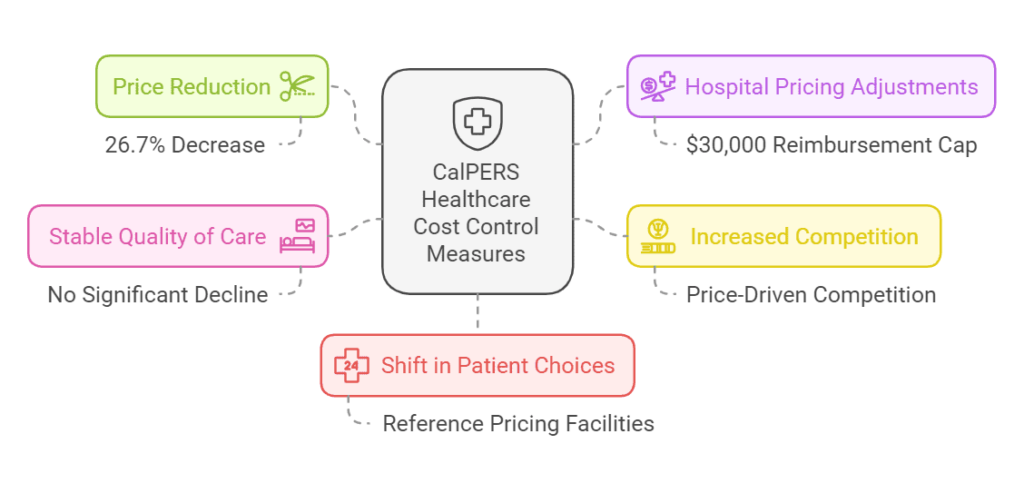
- Price Reduction: The average price CalPERS paid fell 26.3% in 2011. After adjusting for patient mix, researchers credited reference pricing with a 20.2% ($7,028 per case) drop.
- Hospital Pricing Adjustments: Higher-priced hospitals cut their average price 34.3%, toward the $30,000 limit.
- Shift in Patient Choices: Volume at designated lower-price hospitals rose 21.2%, and fell 34.3% at high-price hospitals.
- Quality Screening: Designated hospitals had to meet quality standards. The study did not measure clinical outcomes.
A firm price can push hospitals to price more efficiently. Similar models could extend to other procedures and states.
The Impact of Price Transparency on Cost and Quality
Transparent pricing allows patients to compare costs, which motivates providers to offer competitive rates without compromising quality.
International Examples of Transparency
- Singapore:
- The Ministry of Health publishes fee benchmarks for private hospitals, surgeons and anaesthetists.
- Impact: Close to 90% of doctors charge within the surgeon fee benchmarks, and the 90th percentile surgeon fee fell about 1.7% for procedures with benchmarks (Singapore MOH, 2023).
Singapore also publishes past hospital bill amounts for common procedures, so patients can see typical costs before treatment (Singapore MOH).
- Australia:
- Private platforms such as Zable Health began listing specialist fees and waiting times.
- Outcome: In September 2026, Parliament passed a law letting the government publish the fees medical practitioners charge and likely out-of-pocket costs (Parliament of Australia, 2026).
U.S. Examples of Transparency
- Hospital Price Transparency Rule (2021, strengthened for 2026):
- Hospitals must post a machine-readable file of their charges and a consumer-friendly display of shoppable services (CMS, 2026).
- From 2026, hospitals must post the median, 10th and 90th percentile amounts they were actually paid, and a named senior official must attest that the data is accurate and complete (CMS, 2025).
- Group health plans have their own price transparency requirements.
- Employer Innovations:
Walmart's Centers of Excellence (COE) program connects employees with national experts for spine and heart surgery, joint replacements and certain cancers. Walmart pays bundled prices directly to the health systems, bypassing insurers.- Result: Of the 2,300 Walmart associates referred to a COE for spine surgery, more than half did not need surgery and found more appropriate, less expensive treatment. COE patients also had shorter stays and lower readmission rates (Walmart, 2019).
- Walmart shows how employers can influence care quality and costs through direct contracts.
Consumer Benefits
A 2014 JAMA study of 502,949 insured patients found that those who searched prices before care paid 13.2% less for advanced imaging (about $125 per claim) and 13.9% less for lab tests.
Clear prices also make billing errors easier to catch, because patients and insurers can question a bill that does not match.
Where Price Transparency and Competition Have Fallen Short
Some initiatives have not delivered the expected benefits.
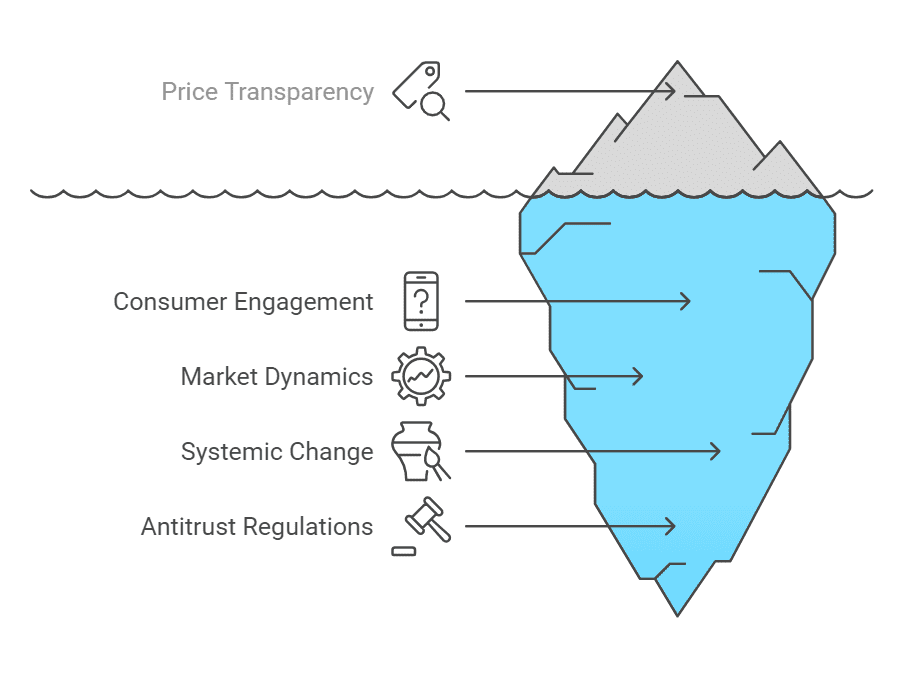
Example: Lack of Consumer Engagement
Many consumers do not use transparency tools. A 2016 JAMA study found only 10% of employees offered a tool used it in the first year, and offering it was not linked to lower spending (JAMA, 2016).
Potential Fix: Build simpler tools into plan platforms and reward lower-cost choices in plan design.
Example: Market Consolidation
In consolidated markets, dominant providers can keep prices high even when they are public. RAND found that hospital market power explains more of the variation in hospital prices than a hospital's share of Medicare or Medicaid patients (RAND, 2024).
Potential Fix: Enforce antitrust rules and encourage new market entrants.
Policy Recommendations
Strengthen Enforcement
- Daily fines top out at $5,500 for hospitals with more than 550 beds (45 CFR 180.90), and since 2026 CMS can cut penalties 35% for hospitals that waive an appeal hearing, except for core violations (CMS, 2025). Penalties should make compliance cheaper than ignoring the rule.
Promote Competitive Markets
- Enforce antitrust laws to limit excessive consolidation. Federal and state governments should closely monitor mergers and acquisitions in healthcare.
Expand Consumer Tools
- Develop easy, mobile-friendly platforms for comparing prices and quality.
Educate Consumers
- Run public awareness campaigns that show patients how to use transparency tools.
Encourage Value-Based Care
- Shift payment from fee-for-service to value-based care, so cost cuts do not come at the expense of quality.
Conclusion
Competition and price transparency are essential levers for lowering U.S. healthcare costs. Evidence from the U.S. and abroad supports their potential, but results depend on enforcement, usable tools and competitive markets.
They are not cure-alls, but they are critical parts of a more efficient healthcare system.
Sources
- Centers for Medicare & Medicaid Services, National Health Expenditure Fact Sheet (historical NHE, 2024), accessed November 2026.
- RAND Corporation, Prices Paid to Hospitals by Private Health Plans: Findings from Round 5.1 of an Employer-Led Transparency Initiative, December 10, 2024.
- KFF, Americans’ Challenges with Health Care Costs, updated October 23, 2026.
- KFF, 2026 Employer Health Benefits Survey, 2026.
- Association for Accessible Medicines, 2026 U.S. Generic & Biosimilar Medicines Savings Report, September 2026.
- Robinson JC, Brown TT, Health Affairs, Increases in Consumer Cost Sharing Redirect Patient Volumes and Reduce Hospital Prices for Orthopedic Surgery, August 2013.
- Singapore Ministry of Health, New Fee Benchmarks for Private Healthcare Sector, June 14, 2023.
- Singapore Ministry of Health, Hospital Bills and Fee Benchmarks, accessed November 2026.
- Parliament of Australia, Health Legislation Amendment (Improving Choice and Transparency for Private Health Consumers) Bill 2026, bill history, assented September 18, 2026.
- Centers for Medicare & Medicaid Services, Hospital Price Transparency (MLN fact sheet MLN7215754), March 2026.
- Centers for Medicare & Medicaid Services, CY 2026 OPPS and ASC Final Rule: Hospital Price Transparency Policy Changes, November 21, 2025.
- Electronic Code of Federal Regulations, 45 CFR 180.90, Civil monetary penalties, current as of November 2026.
- Walmart, News release on the Walmart Centers of Excellence program and Harvard Business Review findings, March 13, 2019.
- Whaley C, et al., JAMA, Association Between Availability of Health Service Prices and Payments for These Services, October 2014.
- Desai S, et al., JAMA, Association Between Availability of a Price Transparency Tool and Outpatient Spending, May 2016.