
In this article 9 sections
- What insurers filed for 2027 small group renewals
- Why some filings charge you for groups that leave
- What the Benefitra simulator shows moved between 2026 and 2027
- Where the shift is largest, and where it barely moves
- Filed is not approved: what Maryland and New York did
- Three tests before you move a group to level funded
- What level funded gives up
- How to run the numbers on your own group
- FAQ

Small group insurers filed a median 14% increase for 2027 renewals [1], and some of them say in their filings that part of the request pays for healthy employers leaving the pool. For HR and finance leaders, founders, and operators at companies with roughly 20 to 250 employees, that makes the level funded vs fully insured decision more urgent: over a five-year period, level funded will often beat fully insured on cost for healthier groups, and our 2027 model puts the median odds at 91% for a 30 employee group, but it also brings claims risk and is not guaranteed renewable.
That changes the question at renewal. It is no longer only "level funded or fully insured, which costs less this year." It is also "do I want to keep paying into a pool that reprices around the groups that walk out, or take on more risk for a better chance at long-run savings." Below is what the 2027 small group renewal filings say, what two states approved, how level funded and fully insured compare, where level funded risk shows up, how to run the premium and claims tests, and what our funding simulator shows for a 30 employee group.
What insurers filed for 2027 small group renewals
The Peterson Center on Healthcare and KFF reviewed proposed 2027 small group rates from 295 insurers across 50 states and DC. The median request is 14%. The middle half of insurers asked for between 10% and 18%, and 59% asked for 10% to 20% [1]. Six insurers asked for more than 30% [2]. The median entering 2026 was 11% [2].
Read those numbers with two cautions. The 14% counts each insurer once, so it is not weighted by enrollment. And it is a request, not an approved rate.
The trend behind the requests is high. The median medical trend in a subset of 82 filings across 14 states and DC was 10.8% [1]. PwC puts 2027 group medical cost trend at 9%, its highest in 17 years [6]. Mercer's survey of more than 1,800 employers projects total health benefit cost per employee rising 8.2% in 2027 after cost cutting, and 11% if employers change nothing. The 2026 figure was 6.7%, and 59% of the surveyed employers plan cost cutting changes [5]. The gap between 11% and 8.2% is the room an employer has to act, and funding choice is one lever, though some employers stay with fully insured plans because a fixed premium can make budgeting easier as healthcare costs rise and the insurance carrier takes on the financial risk.
Why some filings charge you for groups that leave
Fully insured small group enrollment has shrunk from about 17 million lives in 2013 to about 10 million in 2024 [1]. When a low claims group moves to level funding, the group left behind is sicker on average, and the next rate has to cover that.
Some filings say this directly, according to the Peterson KFF review [1]:
- CDPHP UBI in New York reported enrollment down 33% from March 2025 to March 2026 and applied a 1.2% morbidity adjustment.
- UnitedHealthcare Insurance Company in Kansas adjusted claims 3% for the risk of small employers dropping out of the fully insured market.
- Moda in Oregon said lower cost small groups were finding more favorable rates elsewhere.
In Massachusetts, a Mass General Brigham filing cited state data showing level funded plans growing from 2% of the merged market in 2021 to over 11% in 2025 [1]. Level funded plans sit outside ACA community rating and are not guaranteed renewable [1].
Put the loads in dollars. On every $1,000,000 of annual premium, a 1.2% adjustment is $12,000 and a 3% adjustment is $30,000. That is small beside a 14% request, which would be $140,000. But it buys you nothing, and the healthier your group, the less sense it makes.
What the Benefitra simulator shows moved between 2026 and 2027
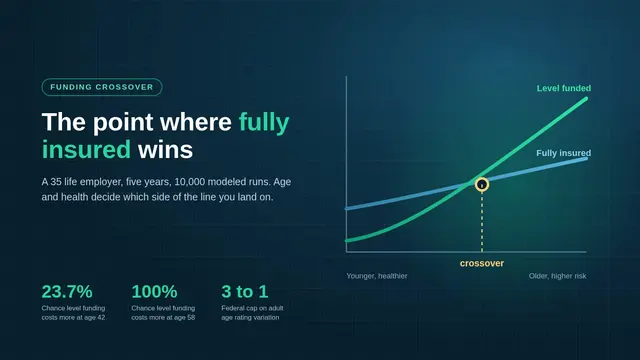
We ran our own numbers for the same question. The health insurance plans page publishes modeled five year results by state and employer size, with the 2027 rate basis. The methodology page explains the model. Here is the 30 employee result for a level funded plan, a hybrid approach that blends fixed, predictable monthly payments with potential refunds if claims are lower than expected, across the 47 states where a level funded result exists [8]:
| Measure (30 employees, level funded) | 2026 | 2027 |
|---|---|---|
| Median odds of beating fully insured over 5 years | 88% | 91% |
| Range across states | 84% to 92% | 86% to 94% |
| States at 90% or better | 13 | 34 |
| Median of state median 5 year savings | $433,424 | $588,691 |
The odds rose in 44 states, held in 2 and slipped in 1. Median savings were higher in 46 of 47 states.
These are modeled outputs, not quotes. The page marks 18 states as using final or final filed 2027 rates and the rest as using requested filings.
Where the shift is largest, and where it barely moves
The change is not uniform. Here are five states from the same data set [8]:
| State | 2026 odds and median savings | 2027 odds and median savings |
|---|---|---|
| Texas | 90%, $455,372 | 92%, $654,723 |
| New Jersey | 90%, $613,899 | 93%, $893,650 |
| Ohio | 91%, $495,719 | 94%, $727,398 |
| Maryland | 87%, $447,958 | 89%, $564,172 |
| Mississippi | 84%, $249,348 | 86%, $292,743 |
Two things stand out. First, Maryland uses a final approved rate in our model, and the odds still rose two points. The shift is not only an artifact of padded requests. Across the 16 final rate states with a level funded result, median savings rose 29.2%, against 33.6% across all 47 states. You can see the Maryland results by employer size yourself.
Second, size matters. At 10 employees the median odds moved from 76% to 81%. At 70 employees they stayed at 91% in both years, though median savings still rose from $328,816 to $381,895 [8].
We have not isolated how much of the shift comes from the morbidity loads in the filings. Read the filings and the simulator as pointing the same way, not as cause and effect.
Filed is not approved: what Maryland and New York did
Budgeting a renewal at the filed rate is the safe move. Planning on that rate being the final one is not always right.
| State, small group | Requested | Approved | Gap on $1,000,000 of premium |
|---|---|---|---|
| Maryland | 13.1% | 10.2% | $29,000 |
| New York | 23.7% | 8.0% | $157,000 |
The Maryland Insurance Administration announced its approvals on September 25, 2026 [3]. The New York Department of Financial Services announced its on September 4, 2026 [4]. The New York figures come from a republished copy of the department's release, which we flag for confirmation.
The Maryland Insurance Administration also broke down the cost drivers: hospital trend of 7.8%, professional services 8.6% and prescription drugs 14.8% [3]. Those are the same forces pushing filings up elsewhere.
The practical rule: budget at the filed rate, then check what your state regulator actually approved. Both states cut the request. Ask your carrier whether your state reviews small group rates before they take effect, because that decides whether a cut is even possible.
Three tests before you move a group to level funded
This is not a pros and cons list. Run three tests, in this order, because the choice depends on the company's risk tolerance, administrative capacity, and cash flow, not just price.
- The claims test. Get 24 months of paid claims, run out, from your current carrier. Compare them with the premium you paid. A group that pays far more in premium than it uses in claims is the group the pool counts on, and the group that gains most from leaving.
- The single claimant test. At around 30 employees, one high cost claimant can move next year's price. Our 30 person operations case study makes this point about level funded plans, which are experience rated. Ask whether the stop loss carrier will raise the deductible for a known claimant at renewal. stop loss insurance provides stop loss protection that caps catastrophic exposure, but it does not remove all direct financial responsibility under a level funded arrangement.
- The exit test. Ask in writing what happens at month twelve if claims run high. Level funded plans are not guaranteed renewable [1]. Confirm what the carrier will offer, and whether fully insured coverage stays available to you afterward. Choosing between fully insured and level funded plans depends on balancing financial risk and administrative capacity, and fully insured plans may be the better fit for older workforces or groups that want less administrative burden. Level-funded plans also require more administrative involvement from employers.
If the first test looks good and the others look manageable, level funded deserves a real quote. If the first test is weak, the pooling in fully insured coverage may be worth its price. Our older post on when fully insured is better covers that side.

What level funded gives up
A 91% median odds figure still means level funded loses to fully insured in about 9 of every 100 simulated five year paths. In Mississippi, at 86%, it is 14 of 100. That downside usually arrives as a bad claims year followed by a hard renewal. We wrote about that in level funded after a high claims year.
There are structural differences too: fully insured plans transfer all claims risk to the insurance carrier, but that usually means less control and limited claims utilization reporting because the carrier owns the risk. KFF's 2025 employer survey found level funded plans use health status in rating and need not cover all essential health benefits [7]. The same survey found 37% of covered workers at firms with 10 to 199 workers were in level funded plans, similar to the year before [7]. That is 2025 data, but it shows how common the choice has become.
Compare benefit design line by line, not only the monthly payment. Check drug coverage, the provider network, and what employees pay at the point of care. A level-funded arrangement can offer more control over plan design, but the trade off is more employer involvement in claims management and oversight. A cheaper structure that raises employee costs can cost you in retention.
Mercer found GLP1 drugs, AI assisted coding and No Surprises Act arbitration each add about one point to 2027 cost [5]. Ask each quote how it treats them.
How to run the numbers on your own group
Start with the renewal you actually received, not the market median. The right funding structure should fit your budget, cash flow, and risk profile, not just the quoted monthly cost. Then work through these steps:
- Enter your headcount and state in the funding simulator and note the level funded odds and the savings range.
- Put your renewal through the premium renewal stress test to see what a 14% request, and a lower approved rate, would do to your budget.
- Compare the fully insured renewal with a level funded quote on employee cost, not just employer cost. Both options can offer predictable monthly payments, but a level funded quote may also include upside from unused claims funding.
- Ask for the level funded renewal terms and the stop loss contract before you sign, so you know the second year price logic. Specifically, ask how the quote handles the claims fund, administrative fees, and stop-loss terms, and whether unused claims funds can be returned at the end of the plan year.
Our level funded overview explains the mechanics, and the renewal stress test guide walks through the budget side. If your group is healthy and your renewal is near the filed median, the 2027 numbers make the level funded quote worth requesting. If your group has a known high cost claimant, get that quote anyway, but weigh it against the fully insured rate with much more care.

FAQ
What is the average small business health insurance renewal increase for 2027?
The median proposed increase is 14% across 295 small group insurers, with the middle half between 10% and 18% [1]. It is a request, not an approved rate, and it is not weighted by enrollment.
Is level funded cheaper than fully insured in 2027?
For a healthy 30 employee group, our modeled median odds of level funded beating fully insured over five years are 91% for 2027, up from 88% for 2026 [8]. It is a model, so your own claims history decides the answer, and the potential cost savings in a level funded option can include refunds of unused claims funds when actual claims come in below expected levels.
Should a healthy group leave the fully insured pool at renewal?
Some insurers add a charge for the risk of groups leaving [1], so staying can cost you. Leaving means taking on claims risk, while staying fully insured keeps predictable costs with fixed monthly premiums because they remain spread across the community pool [1]. Run the claims, single claimant and exit tests first.
Will my approved renewal be lower than the requested rate?
It can be. Maryland approved 10.2% for small group against 13.1% requested [3], and New York approved 8.0% against 23.7% [4]. Ask your carrier whether your state reviews rates before they take effect.
What happens to level funded after a bad claims year?
The renewal is experience rated, so your own claims drive next year's price, and the plans are not guaranteed renewable [1]. After a bad claims year, a level-funded arrangement also leaves the plan sponsor with federal law compliance duties, including ERISA rules, ACA reporting, annual PCORI fee filings, COBRA premium calculations, and Section 105(h) nondiscrimination review. Ask for the renewal terms and stop loss contract in writing before you sign.
Sources
- Peterson Center on Healthcare and KFF, Health System Tracker, "How much and why premiums are going up for small businesses in 2027," August 6, 2026. https://www.healthsystemtracker.org/brief/how-much-and-why-premiums-are-going-up-for-small-businesses-in-2027/
- Healthcare Dive, "Insurers want to hike small businesses’ premiums by 14% next year: KFF," August 7, 2026. https://www.healthcaredive.com/news/small-business-health-insurance-premiums-2027-kff-rate-filings/827247/
- Maryland Insurance Administration, "Maryland Insurance Administration Approves 2027 Affordable Care Act Premium Rates," September 25, 2026. https://insurance.maryland.gov/Pages/newscenter/Maryland-Insurance-Administration-Approves-2027-Affordable-Care-Act-Premium-Rates.aspx
- New York State Department of Financial Services, "Department of Financial Services Announces 2027 Health Insurance Premium Rates Saving New Yorkers $1.6 Billion," September 4, 2026, as republished by EIN Presswire. https://www.einpresswire.com/article/939709457/department-of-financial-services-announces-2027-health-insurance-premium-rates-saving-new-yorkers-1-6-billion
- Mercer, "Survey: Health benefit costs expected to jump 8.2% in 2027, the biggest increase since 2003," August 31, 2026. https://www.mercer.com/en-us/insights/us-health-news/survey-health-benefit-costs-expected-to-jump-in-2027/
- PwC, "Medical cost trend: Behind the Numbers 2027," June 11, 2026. https://www.pwc.com/us/en/industries/health-industries/library/behind-the-numbers.html
- KFF, "2025 Employer Health Benefits Survey," October 22, 2025. https://www.kff.org/health-costs/2025-employer-health-benefits-survey/
- BENEFITRA, Health Insurance Plans state results (own modeled data, 2027 rate basis) and Funding Simulator Methodology, accessed September 29, 2026, page undated. https://benefitra.com/health-insurance-plans/